

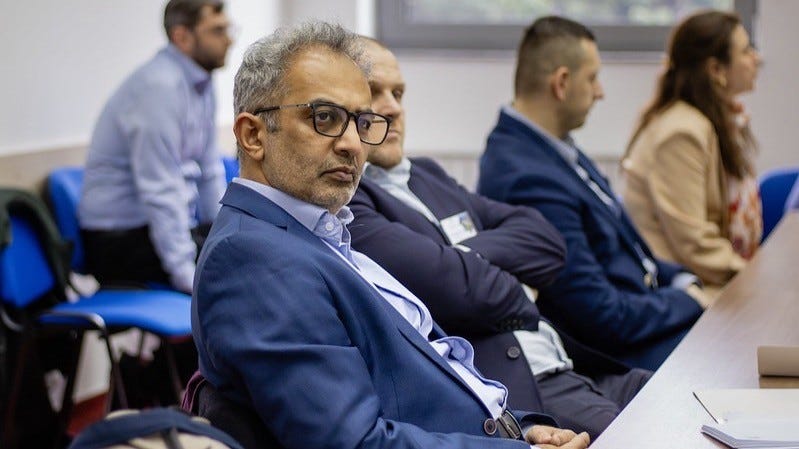
For almost fifteen years, I have worked to promote the ideas of a free and responsible society. My work has taken many forms and has been carried out through different institutions and platforms, but the central conviction has remained the same: human beings flourish when they are free to think, believe, speak, associate, trade, and build their lives with dignity and responsibility. In the Muslim world, this conviction requires both intellectual courage and moral patience. It requires us to speak about economic freedom, political freedom, and religious freedom not as imported slogans, but as values deeply relevant to the wellbeing of Muslim societies.
Since the founding of the network in 2011, now known as the Islam and Liberty Network—earlier known as the Istanbul Network for Liberty—we have tried to create a space where scholars, researchers, public intellectuals, and practitioners can explore the relationship between Islam and the principles of a free society. Our mission has never been to imitate the West, nor to reduce Islam to a political ideology. Rather, it has been to demonstrate that the universal values of religious, political, and economic freedom are not alien to Islam; indeed, they are necessary for peace, prosperity, and human dignity. This is consistent with the Network’s stated mission to advance understanding of these freedoms in Muslim-majority countries and beyond.
Over the years, we have met many respected individuals and institutions who do not agree with us. Some come from secular backgrounds; others from religious traditions. Some are based in Muslim-majority countries, while others live in Western societies where Muslims are significant minorities. We have encountered suspicion from different directions. Some secular intellectuals believe that Islam cannot be reconciled with liberty. Some religious intellectuals fear that liberty means moral disorder or cultural surrender. Between these two objections lies the difficult but necessary terrain of our work: to show that freedom and responsibility must be understood together, and that a free society requires moral foundations as much as it requires institutional protections.
In recent years, however, this work has become more challenging than before. The war between Hamas and Israel since October 2023, and more recently the war following the U.S. attack on Iran in March 2026, have dramatically changed the intellectual and emotional climate in which we operate. Across Muslim societies, the space for talking about liberal ideas, free institutions, and open societies has shrunk. Many friends who once had some appreciation for our work now ask whether the language of freedom is merely a mask for geopolitical power. They see Western governments speaking of human rights, democracy, and liberty while acting inconsistently or selectively in moments of crisis. For them, this appears not as imperfection, but as hypocrisy.
This perception has real consequences. When Western nations fail to live up to their own principles, the credibility of liberty itself is damaged in the eyes of many non-Westerners. The tragedy is that the failure of governments is then used to discredit the moral and institutional value of freedom. Liberal ideas are treated as Western tools rather than universal protections. The right to dissent, the freedom of conscience, the rule of law, limited government, voluntary exchange, and peaceful coexistence are dismissed because powerful states have violated or selectively defended them. In such a climate, it becomes harder to argue that liberty belongs to all humanity and not to any single civilization.
There has also been a practical cost. One implication of these catastrophic events has been the closure, suspension, or withdrawal of support for work like ours by several Western foundations. Many institutions that once supported intellectual engagement in the Muslim world have become more cautious, more constrained, or more inward-looking. This is understandable in one sense; donors face their own pressures, controversies, and reputational risks. But the result is that organisations working patiently on ideas, dialogue, and long-term social change are left more vulnerable precisely when their work is most needed.
At the same time, we have never been popular in Muslim philanthropic circles. Many Muslim donors understandably prioritize humanitarian relief, education, healthcare, and religious giving. These are noble and necessary causes. A family in hunger, a child without schooling, a patient without treatment, and a community without basic religious services all deserve urgent attention. Yet societies are not shaped by material needs alone. They are also shaped by ideas—by what people believe about authority, responsibility, markets, justice, pluralism, and the moral status of the individual. If we do not invest in ideas, we leave the future to those who do.
This is why I remain grateful to organizations such as Atlas Network, which have continued to support us in difficult circumstances despite facing opposition. Support of this kind is not merely financial; it is a vote of confidence in the possibility of principled dialogue. It recognizes that Muslim societies need their own voices, their own scholars, and their own institutions to articulate a case for freedom from within their moral and civilizational context. No lasting reform can be imposed from outside. It must be discovered, argued, translated, and owned from within.
For this reason, we have started working more deliberately to develop a community of supporters across countries. We need friends, donors, scholars, entrepreneurs, students, religious leaders, and civic actors who understand that the defense of liberty cannot depend on a few foreign grants or a small circle of committed individuals. It must become a community effort. It must involve those who believe that Muslim societies deserve more than authoritarian politics, state-controlled economies, sectarian suspicion, and intellectual isolation. They deserve societies where faith is protected without coercion, markets serve human creativity, governments are accountable, and disagreement does not become enmity.
In today’s climate, opposition to the West can be an easy language of mobilization, and rejection of liberalism can sound like authenticity. But this is not our mission. We are not here to fight the West as a civilization, nor are we here to defend every action of Western governments. We are also not here to promote liberalism as a tribe or identity. We are here to defend freedom as a moral and institutional necessity for human beings, including Muslims.
This distinction matters. If liberty is reduced to Western power, it will be rejected by those who have suffered from that power. If Islam is reduced to political resentment, it will be unable to offer a constructive vision for human flourishing. Our task is to escape both traps. We must criticize hypocrisy without abandoning principle. We must oppose injustice without surrendering to authoritarianism. We must defend Muslim dignity without denying the dignity of others. We must insist that religious freedom protects Muslims where they are minorities and protects non-Muslims and dissenting Muslims where Muslims are the majority. We must insist that economic freedom is not selfishness, but a framework that allows people to create, cooperate, and rise out of dependency. We must insist that political freedom is not chaos, but the peaceful limitation of power.
The Islam and Liberty Network has sought to advance this conversation through conferences, publications, workshops, podcasts, and research. Our work is modest in resources, but ambitious in purpose. We try to bring together people who may disagree strongly but are willing to reason together. We seek to move beyond slogans and ask difficult questions: What does freedom of conscience require in Muslim societies? How can markets be reconciled with social justice? What institutions protect pluralism? How can Islamic moral thought contribute to constitutionalism, voluntary cooperation, and peaceful coexistence? These are not abstract academic questions. They shape whether young Muslims inherit societies of fear or societies of hope.
I admit that I feel lonelier than before. The intellectual space is narrower, the funding environment is harder, and the emotional temperature of intellectual debate is higher. Yet loneliness is not the same as defeat. Many worthwhile causes begin with small circles of people who refuse to abandon difficult truths. The fact that our work has become harder may be evidence that it has become more necessary. When societies polarize, the work of bridge-building matters more. When slogans dominate, careful thinking matters more. When people lose trust in freedom because of the failures of powerful states, it becomes even more important to recover freedom as a universal human aspiration and an Islamic moral concern.
The way forward is not easy. We must broaden our base of support, deepen our scholarship, strengthen our networks, and speak with humility as well as conviction. We must listen honestly to the anger and disappointment felt across Muslim societies, especially when they arise from real suffering and injustice. But we must also remind our friends that abandoning liberty will not heal these wounds. A world without freedom of conscience, without accountable power, without open inquiry, without voluntary exchange, and without peaceful pluralism will not be more Islamic, more just, or more dignified. It will only be more closed.
My hope is that we will find new friends, supporters, and partners as we continue this journey. The Islam and Liberty Network cannot do this work alone. Nor should it. The case for a free and responsible society in the Muslim world must be carried by many voices, in many languages, across many countries. It must be rooted in faith, reason, lived experience, and institutional imagination. If we succeed, even partially, we will help create a future in which Muslims do not have to choose between their faith and their freedom, between moral responsibility and open society, between solidarity with their communities and respect for universal human dignity.
That future is worth working for, even when the work is difficult. Perhaps especially then.
The line that stands out to me is that a free society requires moral foundations as much as institutional protections. That is the case for why Islamic education belongs inside this project rather than beside it. A student who is only ever given conclusions, this is permitted, this is not, without being taught how the tradition reasons its way to those conclusions, is not equipped to hold a considered view on anything, including liberty itself. Freedom of conscience presumes a conscience that has been trained to weigh evidence and argument rather than just receive verdicts. That is the piece of this work we focus on in Islamic curriculum design: teaching the reasoning tools before asking anyone to accept a position on our authority alone. We write about this sequencing question in depth at thefoundationspress.com.