

“Who rules East Europe commands the Heartland; who rules the Heartland commands the World-Island; who rules the World-Island commands the world.” Sir Halford Mackinder wrote these words in 1919. According to his thesis argument, geography shapes power. More than a century later, Eurasia is showing that connectivity has become a major source of power.
Azerbaijan is a pivotal player in this evolving map. It is located between Central Asia, the Caspian Sea, the South Caucasus, and Europe. This makes Baku unique compared to landlocked countries in having a direct maritime connection to the west. Azerbaijan is opening a door for Central Asia to the markets of Türkiye and Europe. Central Asia offers connecting links for Azerbaijan to China and the rest of the Eurasian economy. The relationship is therefore moving beyond transit toward deeper economic cooperation. It is becoming a partnership built on growing economic interdependence.
The Middle Corridor is at the centre of this transformation. In 2017, the Trans-Caspian International Transport Route (TITR) was formed. It is now at the centre of this transformation, connecting China to Europe through Central Asia, the Caspian Sea, Azerbaijan, Georgia, and Türkiye. In the 19th century, external empires were competing for Central Asia and the Caucasus for dominance in the “Great Game era”. Today, the countries of the region are asserting control over their own destinies.
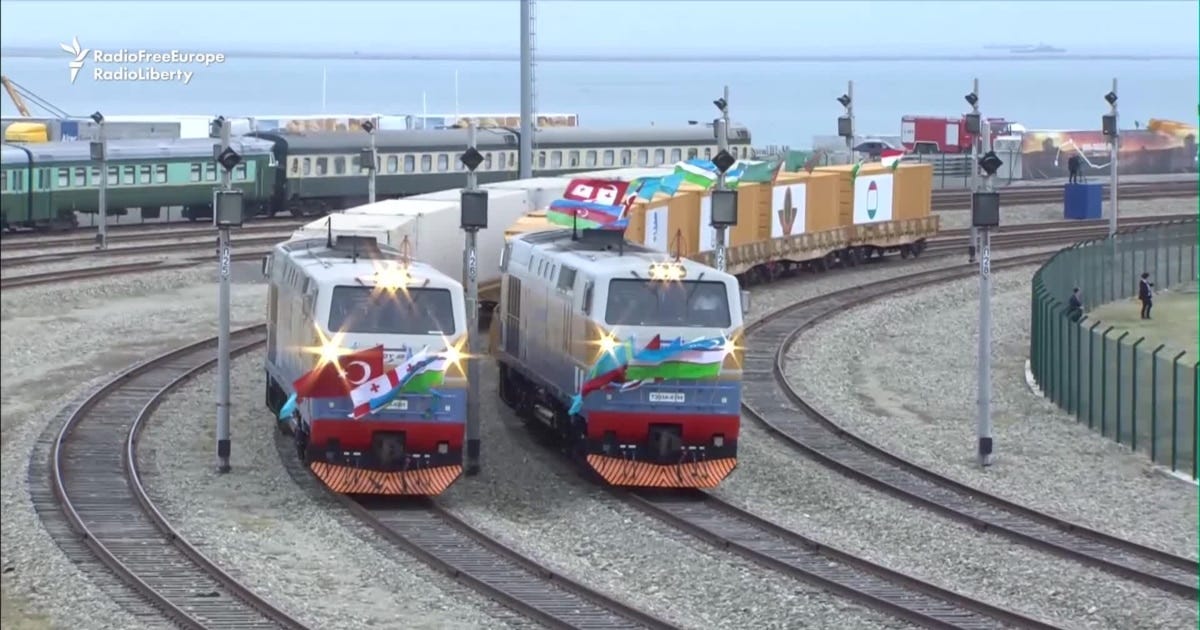
The Baku-Tbilisi-Kars (BTK) railway is a new route that opened in 2017 and links Azerbaijan with Georgia and Türkiye. The Port of Alat then connects the railway network to the Caspian Sea trade and enhances Azerbaijan’s bridgehead between Central Asia and Europe, land and sea. The data shows that this strategic vision is already underway. In the first 11 months of 2025, Azerbaijan Railways handled 350 block trains from China, including 128 transit trains. Cargo volume in containers grew by 18% to 123,992 TEU. In 2024, container traffic reached 96,952 TEU, an increase of 40.8%. The Middle Corridor is about 2,500 kilometers shorter than the traditional northern route through Russia. Goods can get from China to Europe in 10-15 days, which is faster than the traditional way.
Azerbaijan is also expanding its connectivity beyond the Middle Corridor. It is part of the International North–South Transport Corridor (INSTC), a multimodal network designed to connect India with Russia and Northern Europe through Iran and Azerbaijan. The corridor was formed in 2000 by Russia, Iran and India, followed by Azerbaijan in 2005. The International North–South Transport Corridor is a multimodal transit line of approximately 7,200 kilometres which links the North Sea with the Indian Ocean. For Baku, it provides another important trade route, complementing its east–west connections through the Middle Corridor. This places Azerbaijan on the crossroads of the north–south and east–west trade routes of Eurasia.
Azerbaijan’s connectivity ambitions extend beyond its existing routes. The planned Zangezur route would connect mainland Azerbaijan with Nakhchivan and Türkiye. The Horadiz–Aghband railway is expected to be completed in 2026. It is expected to produce 15 million tonnes per annum. As for Azerbaijan, relations with Central Asian countries are expanding. At the end of 2025, the amount of mutual trade is USD 1.8 billion. Cooperation has been expanded to customs digitalization, investment, energy and logistics. Uzbekistan is even exploring a joint Caspian maritime fleet with Azerbaijan’s shipping company. That’s why Azerbaijan’s rise is significant. It’s not just about building roads, railways and ports. It is building connections between economies that were once separated by geography. Mackinder viewed Eurasia as the heart of the world. In a globalized world, Azerbaijan demonstrates another aspect of this concept: a country may gain influence by being a bridge between others.