

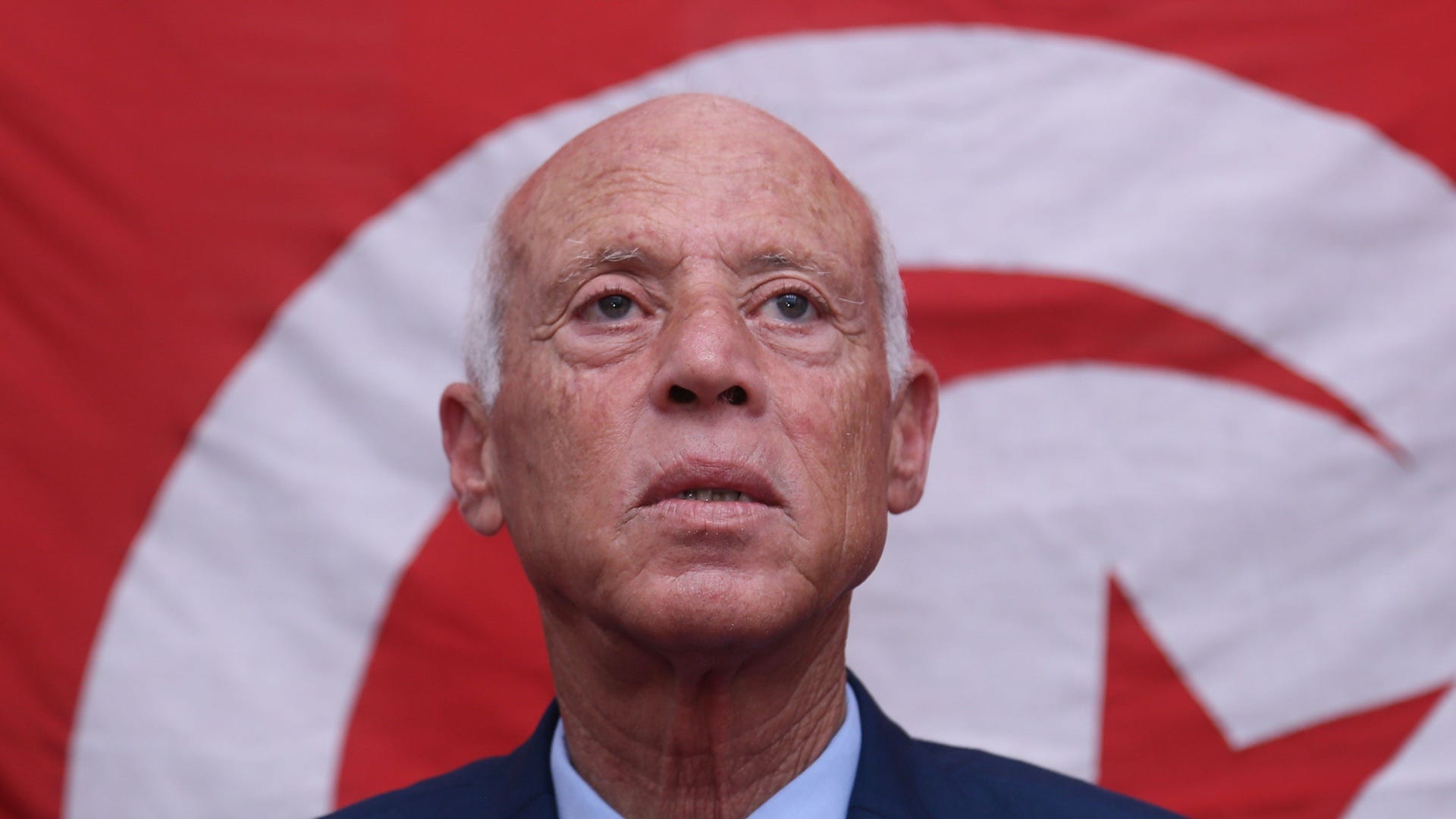
Fifteen years after the Arab Spring, Tunisia is no longer trying to build democracy. It is trying to protect the freedoms it once achieved. Courts have played an increasingly prominent role in the repression of political opponents, journalists and civil society activists since President Kais Saied suspended parliament on 25 July 2021. But Tunisia’s most serious problem is not political opposition. It is the economy. When Saied was elected in 2019, he promised to fight corruption and improve people’s lives. Many supported his move in 2021, hoping it would bring stability and economic recovery. Five years later, those hopes have faded. The government is spending more time targeting opponents than solving economic problems.
The government’s priorities became clear on 8 and 9 July 2026. MP Fatma Mseddi on 9 July introduced a law that would declare the Islamist Ennahda movement a terrorist organisation and prohibit its members from holding public office for a period of 10 years. A day earlier, a Tunisian court sentenced lawyer and former presidential candidate Samir Abdali to 18 years in prison on terrorism and money laundering charges. In the same week, 18 other social media users were also sentenced to up to 27 years under Decree 54, the 2022 cybercrime law that criminalises the government’s definition of ‘false information’. These may be tough, but they will not make many changes. Ennahda is already weak. Its offices were closed in 2023, and many of its leaders, including Rached Ghannouchi, remain in prison. Declaring it a terrorist organisation changes little and shifts attention away from Tunisia’s economic crisis.
The crackdown now goes beyond Ennahda. Politicians, lawyers, journalists and activists are increasingly being targeted. Opposition leaders Abir Moussi, Ayachi Zammel and Lotfi Marraihi have all faced prison or prosecution. In June 2026, anti-racism activist Saadia Mosbah was sentenced to 8 years in prison and human rights defender Sihem Bensedrine was sentenced to 25 years. Zied El-Heni, an Egyptian journalist, was also found guilty of “incitement to violence” and sentenced to five years in prison for his criticism of the judiciary. On 18 June 2026, hundreds of lawyers across Tunisia went on strike, calling it judicial madness. These cases demonstrate that it is becoming increasingly dangerous to criticize the government in Tunisia.
Political parties are not the only ones under pressure. There is also growing restriction of civil society organizations. In April 2026, the government suspended the Tunisian League for the Defense of Human Rights (LTDH) for one month. Accused of receiving suspicious foreign funding. It is one of Tunisia’s oldest and most respected human rights organizations. It was also part of the National Dialogue Quartet, which won the 2015 Nobel Peace Prize for helping Tunisia avoid violence after the Arab Spring. LTDH President Bassem Trifi rejected the decision, saying, “We oppose this decision, and we will lodge an appeal. We will continue our struggle for rights and freedoms.” The former president of the journalists’ union, Mohamed Yassine Jlassi, said the crackdown is expanding and affecting more people. It has come to affect all of us: “Journalism has become a crime, civil society work a crime, political opposition a crime. However, Tunisians are concerned about employment. Hundreds of university graduates protested in Tunis on 8 July 2026 to ask the government to implement the employment law of 23 December 2025. Their protest was part of a broader economic crisis. Unemployment is still at about 15 per cent, and graduate unemployment exceeds 24 per cent. Nearly 30,000 doctors, engineers and other skilled workers leave Tunisia annually for a better future.