

As mentioned in our previous essay published on Edraak earlier, the general outlook of the Muslim world presents a profoundly challenging, mostly negative picture today.
Many Muslim-majority countries in different continents grapple with severe underdevelopment, technological backwardness, acute internal political tensions, and civil unrest. This negative outlook is reflected by the bad performance of the Muslim-majority countries in some leading international indices such as Index of Economic Freedom, Rule of Law Index, Human Development Index, and Corruption Perceptions Index. It is an issue of debate why and how the Muslim world—once stood as the global epicenter of science, philosophy, astronomy, and governance—arrived at this point. It is logical to think the set of factors leading to the decline and unpromising outlook of today falls into two broad categories: external and internal factors.
The contemporary debate surrounding the socio-economic and political challenges faced by many parts of the Muslim world often focuses heavily on macro-level structures—political systems, economic policies, or global historical legacies, i.e., external factors. Many people, especially politicians and intellectuals, tend to refer only to these external factors (Western imperialism, colonialism, military occupation, exploitation, puppet administrations,..) and never mention the internal factors. This is because announcing the external enemies as a scapegoat gives you mental comfort and takes away all responsibility from you.
However, we must place the truth above everything and everyone else and confront painful realities. We cannot see the truth or solve our problems without looking at ourselves in the mirror and engaging in profound self-criticism. The external factors story is just one side of the coin. But there is another, probably a darker side: our own flaws, inadequacies, or mistakes. In this regard, an increasingly prominent perspective argues that our macro-problems are deeply rooted in some micro-foundations: specifically, the daily habits, civic behaviors, work discipline, and moral qualifications of individuals living in our societies.
As mentioned, we have already discussed the major external factors in our previous article. In this article, we are going to focus on one of the two major pillars of the internal factors in explaining the Muslim world’s negative outlook today. In a broad sense, internal factors can be divided into two: 1) Mentality-related, political, institutional problems, 2) Individual, behavioral, habitual, moral problems. In our opinion, the internal factors reflecting themselves at the individual and moral level in our daily lives are as important as external factors and the first group of internal factors in explaining the ongoing reality. Mentality-related problems (fatalism, traditionalism, literalism) have been discussed in another study1. In this short article, we will discuss some other internal and micro-level factors: individual, quality-related, and moral problems.
From this viewpoint, one can argue that the overarching struggles of a society are a direct reflection of its human capital, human quality, and civic culture. When individual standards of everyday ethics and social responsibility decline, the entire societal fabric weakens, making large-scale progress exceptionally difficult to sustain.
The Micro-Foundations of Macro Problems
The argument centers on the idea that national progress, level of welfare, and economic development rely, in the last analysis, on predictable, respectful, productive, and disciplined daily interactions. When basic civic duties and individual responsibilities are widely neglected, societal trust, efficiency, and productive capacity collapse. This manifests in several critical areas of daily life in the following ways:
Keeping your promise, trust and reliability: One of the most important moral conducts—and in fact a religious commandment—is keeping one’s promise. When individuals routinely break their promises or fail to pay debts on time, economic credit systems suffer, and interpersonal trust—the foundation of any functional market—erodes. Failing to keep one’s word constitutes a violation of the rights of others. The economic repercussions of this are highly detrimental.
Punctuality and keeping appointments: Failing to observe scheduled times disrupts professional environments and signals a broader lack of respect for others’ time, hindering organizational productivity. Similarly, failing to keep and not arriving at an appointment on time constitutes a violation of the rights of others. The economic repercussions of this are more detrimental than you think.
Work ethic and work discipline: Work ethic, doing your best at your work, targeting to be the best in your field, and finishing your duties on time are extremely important. Shirking, pretending to work but not doing your job, neglecting your responsibilities at work, or failing to aim for professional excellence lowers the overall quality of goods, services, and governance across a nation. Lower productivity means lower GDP and lower national income per capita.
Civic order, keeping your turn in line: It is a very important moral conduct to keep and wait for your turn in lines. Disregarding waiting for your turn in lines or queues, disrespecting the rights of others in public leads to social decay, undermines trust, leads to a verbal altercation, shoving and pushing, and a fight.
Paying attention to hygiene and cleanliness both at home and in public spaces: Paying attention to hygiene, keeping one’s body, home, and environment, especially public facilities (schools, hospitals, public buildings,...) are extremely important for our health. It is also a religious duty. Disregarding cleanliness and hygiene in public spaces is obviously disrespecting the rights of others. Littering in parks, highways, airports, train stations, and other public facilities leads to physical and social decay, causing epidemic diseases sometimes. A lack of cleanliness in public spaces reflects a deeper breakdown in communal responsibility.
Tolerance and Diversity: High-quality human capital requires an openness to dialogue and a tolerance for differences. A narrow-minded person cannot tolerate any social, political, ideological, religious, or ethnic difference. Disregarding tolerance and adopting a radical-salafi type takfiri (accuser of apostasy) very often leads to violence and breaks down social cohesion. When societies struggle to tolerate diverse perspectives, social cohesion splits, leading to political instability, ethnic, ideological, or religious violence.
The Path Forward: Cultivating Human Capital
According to this perspective, structural reforms—whether political or economic—cannot succeed unless they are built upon a solid foundation of individual character and civic morality. Therefore, the primary strategy for long-term improvement must begin at the individual level.
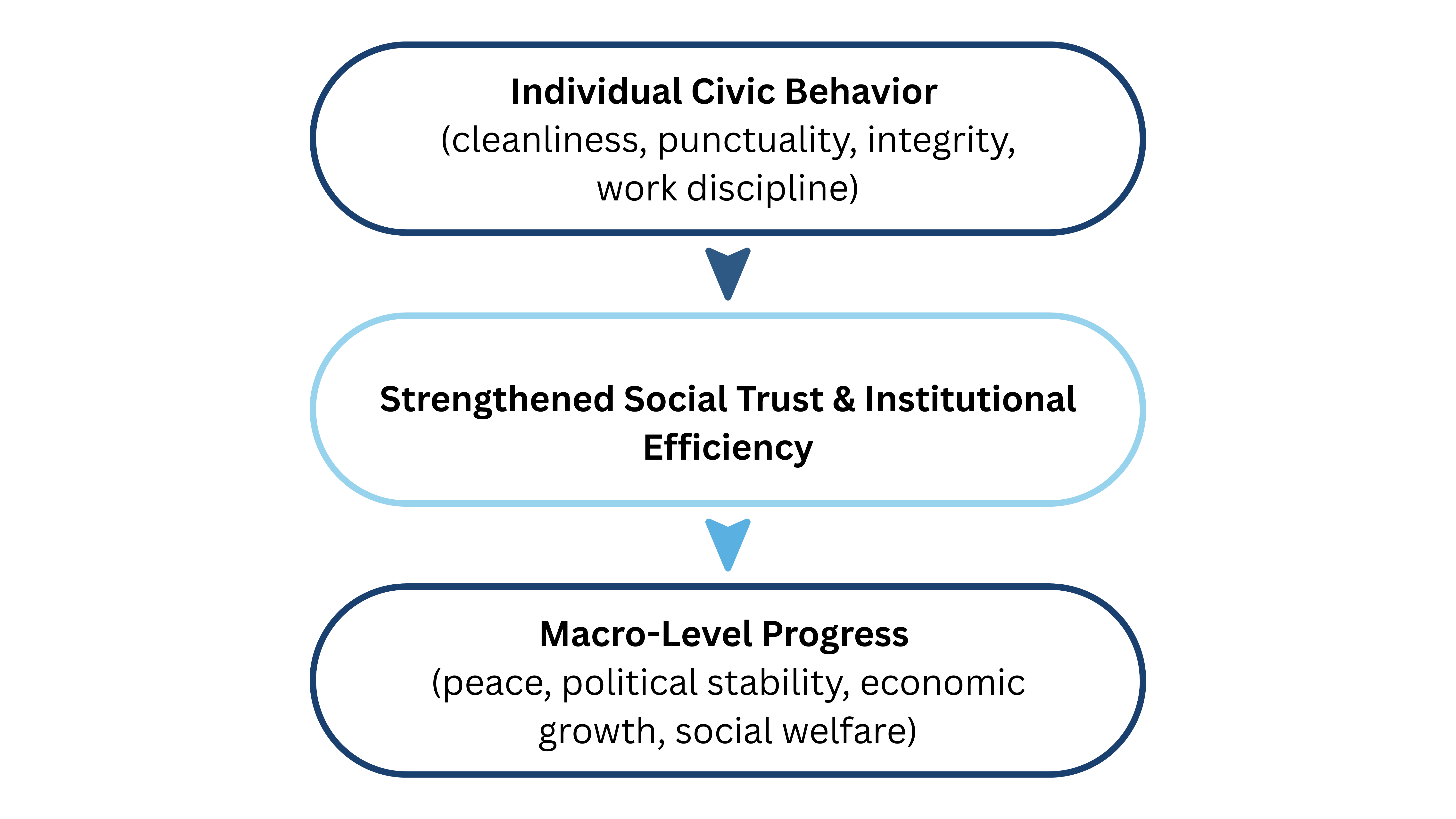
To shift the current outlook, a collective emphasis must be placed on elevating human quality. This involves fostering a culture that prioritizes absolute cleanliness, strict punctuality, unwavering integrity in financial and personal promises, and a deep-seated respect for public order. Furthermore, cultivating virtues like mercy, tolerance, and an openness to dialogue is essential for managing internal differences smoothly.
By systematically improving human capital and individual moral qualifications, societies can create the necessary conditions to resolve their larger social, political, and economic challenges more effectively and sustainably.
This Essay is an extension of a previous article published on Edraak, titled, ”Understanding the Modern Realities of the Muslim World: Current Challenges and Historical Drivers” by Mustafa Acar
1A more detailed discussion can be found in Acar, M. (2016), “Reason versus tradition, free will versus fate, interpretation versus literalism: intellectual underpinnings of the negative outlook for the Muslim world, in Harmouzi N. & Whetstone, L., Islamic Foundations of a Free Society, eds., London: The Institute of Economic Affairs. https://www.academia.edu/42016346/Reason_versus_Tradition_Free_Will_versus_Fate_Interpretation_versus_Literalism_Intellectual_Underpinnings_of_the_Negative_Outlook_for_the_Muslim_world
This connects directly to the sequencing question from your last piece. Nearly every item on this list, punctuality, keeping one's word, work discipline, waiting one's turn, is treated in most Islamic schools as a discipline matter handled through rules and consequences, not as something actually taught with the same rigor as fiqh or Qur'an. Classical adab literature had a whole curriculum for exactly this, formation of character as a distinct discipline with its own texts and sequencing, and it mostly disappeared from modern school schedules. So the micro-foundations you're describing are downstream of a curricular choice, not just a values gap. We treat this as one of the core disciplines in the K-12 sequence we build at The Foundations Press, alongside Aqidah and Fiqh, rather than as a hidden curriculum enforced through discipline slips. More at thefoundationspress.com.