

A New Regional Compact
The Makkah Joint Defence Agreement, signed by Pakistan, Saudi Arabia and Türkiye on 7 August 2026, marks a significant moment in the search for a new regional security order. Its core message is simple: an armed attack against one signatory will be treated as an attack against all. That language invites comparison with NATO’s Article 5, and Turkish Foreign Minister Hakan Fidan described the pact as “technically the same”, although any response will still be shaped by consultation and political judgement.
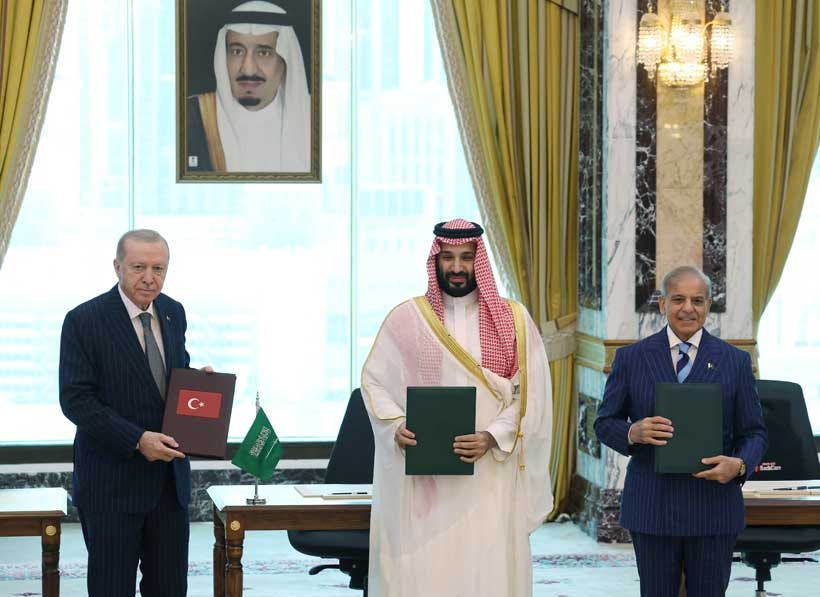
Its symbolism matters. The agreement was concluded in Makkah, Islam’s holiest city, giving a conventional defence pact a wider register of covenant, sanctuary and moral obligation. It links state security to the defence of sacred space and religious dignity. That is why the pact will not be judged only by its response to missiles, drones or attacks on territory. It will also be judged by whether it can articulate a credible collective position on repeated incursions and restrictions at Masjid al-Aqsa, Islam’s third holiest mosque, and on the wider question of whether Muslim-majority powers can defend sanctities as well as borders.
The pact should not be read as a declaration of hostility towards Washington. Saudi Arabia, Pakistan and Türkiye all retain important relationships with the United States. Riyadh still values access to American weapons systems, diplomatic cover and strategic prestige; Pakistan depends on careful management of its international relationships; and Türkiye remains a NATO member. The more accurate interpretation is that these states are hedging against uncertainty. They are not abandoning America. They are preparing for a world in which American protection is no longer sufficient on its own.
Why Now?
The timing reflects a region unsettled by the aftermath of the Hamas attacks of 7 October 2023, Israel’s wars in Gaza and beyond, Iranian reprisals, and the growing sense that Gulf territory is no longer insulated from direct attack. The strike on Doha in September 2025 was especially consequential. Qatar, long treated as a mediator in the Gaza war, suddenly appeared vulnerable inside its own capital. For Gulf capitals, that episode turned abstract discussions about collective defence into a practical question: if one state can be hit, what guarantee can still be trusted?
The answer emerging from Makkah is layered security. The Gulf will continue to cultivate Washington, but it is also building arrangements closer to home. That helps explain why Saudi Arabia can pursue a major civil nuclear cooperation agreement with the United States while simultaneously deepening defence links with Pakistan and Türkiye. The two moves are not contradictory. They are part of the same strategy: diversify risk, widen deterrence and reduce single-source dependency.
The Pact’s Promise — and its limits
Each partner brings a distinct asset. Pakistan offers military depth and nuclear ambiguity. Saudi Arabia brings financial weight, energy centrality and custodianship of the two holy mosques. Türkiye contributes NATO experience, an expanding defence industry and growing regional confidence. Together, they can create a more credible deterrent than any one of them could build alone.
Yet the pact’s weaknesses are equally clear. Ankara’s threat perception is shaped heavily by Israel and the eastern Mediterranean. Riyadh remains deeply concerned by Iran and its network of regional allies. Pakistan must balance Gulf commitments against geography, domestic politics and its relationship with Iran. Even when states sign sweeping defence language, they do not automatically share identical priorities.
That tension has already been visible. During the first phase of the 2026 US/Israel–Iran war, Pakistan did not immediately come to Saudi Arabia’s aid. Instead, Islamabad helped Iran bypass a US naval blockade by rerouting trade through land corridors, before later deploying troops to Saudi Arabia as a ceasefire was agreed. The lesson is that the pact’s deterrent value will depend less on slogans than on operational clarity.
From Symbolism to Capability
Earlier regional defence projects offer a warning. The 1950 Arab League treaty and the GCC’s 2000 Joint Defence Agreement promised solidarity but rarely produced decisive collective action. The Makkah Pact will avoid the same fate only if it develops real military interoperability, joint exercises, shared planning mechanisms, intelligence coordination and credible procedures for responding to crises in the Gulf, the Red Sea, the Strait of Hormuz and conflict theatres such as Yemen, Sudan, Syria and Gaza.
The most durable area of cooperation may be defence industry. Saudi Arabia wants to reduce dependency on external suppliers and emulate elements of Türkiye’s and Pakistan’s domestic defence sectors. A model combining Saudi financing, Turkish technological capacity and Pakistani military-industrial experience could give the pact substance beyond diplomatic theatre. It could also reduce the leverage created by US weapons restrictions, especially those designed to preserve Israel’s qualitative military edge.
The nuclear question remains deliberately opaque. Pakistan has sent mixed signals about whether its nuclear capability could ever extend to partners. Ambiguity can deter, but it can also create dangerous miscalculation. None of the three states has yet clarified whether nuclear deterrence is part of the pact’s logic or merely a shadow behind it.
Regional Reactions
Iran has publicly downplayed concern, but it will watch closely for signs that the pact hardens into an anti-Iranian bloc. The more intriguing spoiler is that Tehran may not be permanently outside the tent: if the agreement is defined as defensive, inclusive and aimed at regional stability rather than regime confrontation, Iran could one day seek some form of association with it. Israel is likely to view the agreement through a different lens: as part of a widening challenge from Türkiye, Pakistan and Qatar to its regional room for manoeuvre. Egypt’s absence is also notable. Cairo’s US military aid, sensitivity over Israel and concern about being drawn into confrontation make its hesitation understandable, although Türkiye has suggested that technical barriers to Egyptian participation may eventually be resolved.
The agreement may also influence a parallel alignment involving India, Israel and the UAE, which links the Gulf more closely to the Indian Ocean and eastern Mediterranean. In that sense, the Makkah Pact is not just a local defence arrangement. It is part of a wider reordering of regional security around multiple axes rather than one American-led centre.
The Real Test
The pact’s central significance is therefore not that it creates an anti-American alliance. It does not. Its significance is that three major Muslim-majority powers are acknowledging the limits of inherited security arrangements and attempting to build strategic depth of their own. For Gulf capitals, the dilemma is stark: Washington remains too powerful to discard, but too risky to rely on alone.
The Makkah Pact will be judged by what follows: whether it produces institutions, exercises, procurement plans, crisis protocols and political courage, or whether it becomes another symbolic declaration in a region crowded with them. Its promise lies in turning shared exposure into shared capability. Its risk lies in confusing rhetoric with readiness.
Volatile geopolitical shifts could still expose divisions among the signatories. For now, however, the pact has been framed as defensive rather than offensive, and as a hedge against uncertainty rather than a bloc aimed at any single state.
Kaleem Hussain is a multi-disciplinary change management consultant, geo-political observer, risk analyst and author of “Peace and Reconciliation in International and Islamic Law (2023).”
References
Reuters. “Turkey, Pakistan, Saudi Arabia defence pact technically same as NATO’s Article 5, Turkish minister says.” 8 Aug. 2026. https://www.reuters.com/world/asia-pacific/turkey-pakistan-saudi-arabia-defence-pact-technically-same-natos-article-5-2026-08-08/
AP News. “Turkey says defense pact with Saudi Arabia and Pakistan is not aimed at Iran or any other country.” 8 Aug. 2026. https://apnews.com/article/turkey-defense-pact-does-not-target-third-countries-1fd785d1c261621f8dcb33010c4f14e2
Responsible Statecraft. “The Mecca Pact could be an opportunity for Iran.” 19 Aug. 2026. https://responsiblestatecraft.org/mecca-pact-iran/
Radio Pakistan. “Pakistan, Saudi Arabia sign Strategic Mutual Defense Agreement.” 17 Sept. 2025. https://www.radio.gov.pk/17-09-2025/pakistan-saudi-arabia-ink-strategic-mutual-defense-agreement
Al Meezan Qatari Legal Portal. “The Joint Defence Agreement of the Cooperation Council for the Arab States of the Gulf.” Production date 31 Dec. 2000. https://www.almeezan.qa/AgreementsPage.aspx?id=1527&language=en
Yale Avalon Project. “Treaty of Joint Defense and Economic Cooperation Between the States of the Arab League, June 17, 1950.” https://avalon.law.yale.edu/20th_century/arabjoin.asp
Reuters. “Israel targets Hamas leadership in military strikes on Qatar, officials say.” 9 Sept. 2025. https://www.reuters.com/world/middle-east/israel-targets-hamas-leadership-military-strikes-qatar-officials-say-2025-09-09/
Reuters. “Israel attacks Hamas leaders in Qatar, Trump says he’s very unhappy about strike.” 9 Sept. 2025. https://www.reuters.com/world/middle-east/israel-attacks-hamas-leaders-qatar-trump-says-hes-very-unhappy-about-strike-2025-09-09/
Reuters. “Israel’s Ben-Gvir visits flashpoint Al-Aqsa Mosque compound.” 23 July 2026. https://www.reuters.com/world/middle-east/israels-ben-gvir-visits-flashpoint-al-aqsa-mosque-compound-2026-07-23/
U.S. Department of Energy. “United States and Saudi Arabia Reach Historic Nuclear Cooperation Agreement.” 22 July 2026. https://www.energy.gov/articles/united-states-and-saudi-arabia-reach-historic-nuclear-cooperation-agreement
Federal Register. “Presidential Determination on the Proposed Agreement for Cooperation Between the Government of the United States of America and the Government of the Kingdom of Saudi Arabia Concerning Peaceful Uses of Nuclear Energy,” Presidential Determination No. 2026-18. 28 July 2026. https://www.federalregister.gov/documents/2026/07/28/2026-15273/presidential-determination-on-the-proposed-agreement-for-cooperation-between-the-government-of-the
