

The cultural identity of Syria has developed very long before the state itself. The country was situated on the crossroads of the Middle East, having been influenced by the Arab, Mediterranean, and other regional civilizations over thousands of years. Damascus and Aleppo, two of its best-known cities, are among the world’s oldest continuously inhabited cities. This long history can be seen in Syrian literature, crafts, food, architecture, and especially music. For centuries, music has played an important role in the cultural life of Syria. The country is home to traditions of Arabic classical music, muwashahat and Sufi devotional singing. It has a musical history of over 3,000 years. The ancient city of Ugarit is connected with the Hurrian Hymn, one of the earliest written pieces of music.
A more recent and prominent role is played by Syrian musicians, who carried this heritage outside the country. The Al-Kindi Ensemble was one of the most famous. The group performed with singers from Damascus, such as Sheikh Hamza Shakkur from the Umayyad Mosque and the Mawlawi whirling dervishes of Damascus, bringing Syrian Sufi music to audiences in Europe, North America, and the Middle East. Music became not just an art form, but an art of sharing Syria’s history and cultural heritage with the rest of the world. This cultural life was seriously affected by the 2011 war. Musicians were sent into exile and cultural institutions closed their doors. Despite this, artists in Syria kept recording music and both within the country and internationally.
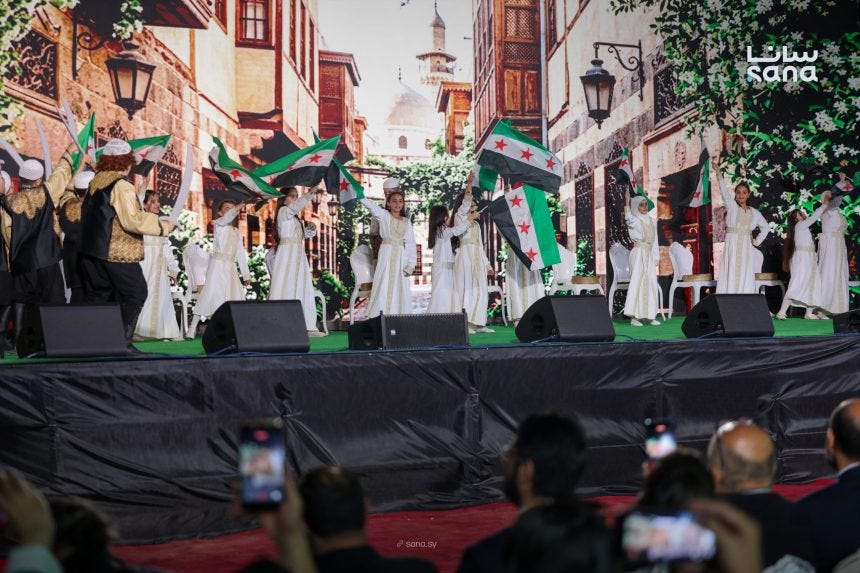
The end of the former regime has since opened a new chapter for Syria’s cultural life. Cultural institutions are returning to public spaces, while literary events, exhibitions and artistic performances are reappearing. These spaces are also creating opportunities for Syrians to discuss questions of memory, identity, war and the future of their society. One example is the Syria Summer Family Festival 2026, organized by Syria’s Ministry of Culture. It started on July 30 in Idlib, then moved to the Damascus Citadel on August 7, and then to Latakia on August 4. The festival continued till August 21. It is travelling across different governorates, allowing people in different areas to experience cultural activities. The festival is a celebration of entertainment and heritage. Its programme includes theatre, storytelling, competitions, traditional performances, muwashahat and religious chanting. The festival featured a puppet theatre performance by “Taraji,” with musical scenes inspired by Damascene heritage, performed by children from the Modern Skills School. Interactive storytelling sessions were also used to make learning fun.
Muhammad Yassin al-Saleh, the culture minister, called culture “one of the bridges uniting Syrian society.” The festival embodies this concept with participation from children, parents, and older adults in historic and cultural venues. The role of music was particularly visible on August 14, when Syrian singer Wasfi Massarani performed patriotic and traditional songs at the Damascus Citadel. He celebrated Syrian heritage and revolution at the Summer Syrian Festival. He also dedicated a song “Yammo Ya Umm al-Shuhada Yammo” for the mothers of martyrs. The audience was singing and chanting. Mohammad Ouda said the event created “a real opportunity for joy after tough years” for him, and Mahmoud Anjiri emphasized the youth’s participation in the event was “a meeting of the different generations”.
For Syria, a land of centuries of cultural mixing and years of conflict. The revival of music, festivals and public cultural events is more than a celebration. It belongs to the great project of re-integrating society with its heritage and re-imagining its future.