

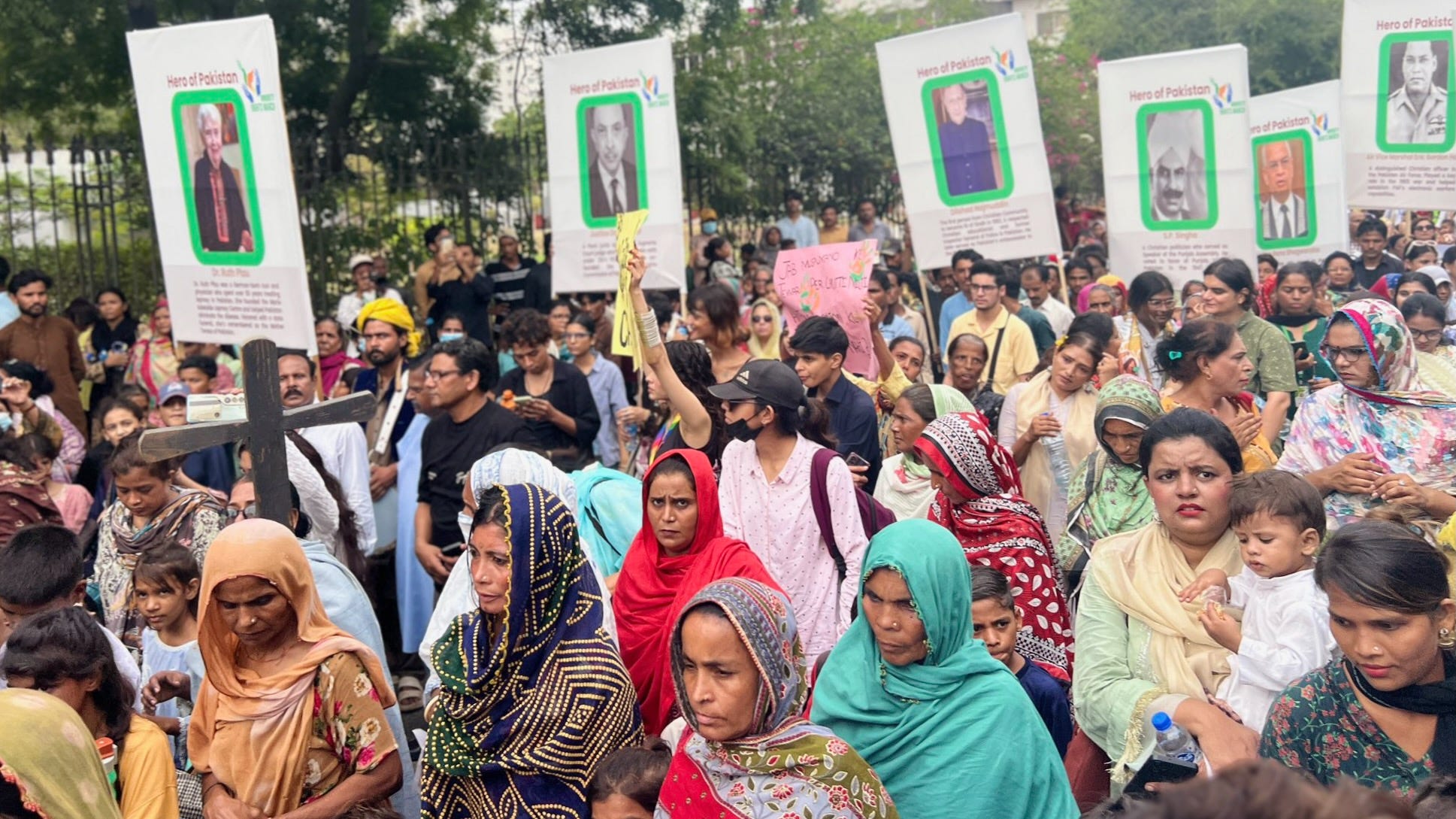
When a country’s founding father promised religious freedoms and rights to all minorities at the time of its formation, those rights should be embedded in the nation’s vision. Yet for discriminatory laws and violence against minorities to persist in such a country despite the constitutional promise of protection highlights the distance still to travel.
The case of minority rights in Pakistan is a case in point. On 11 August 2026, Pakistan officially commemorated the National Minorities’ Day. On the occasion, National Assembly Speaker Sardar Ayaz Sadiq praised the role minorities played in the country’s development.
These contributions came from religious minority communities like Christians, Hindus, Sikhs and Ahmadis—which make up only 4% of the population. Prominent personalities in this context include Justice Alvin Robert Cornelius, who shaped Pakistan’s early legal and judicial framework, and Group Captain Cecil Chaudhry, who dedicated his life to education and advocacy. To celebrate the contributions of these individuals and highlight the issues faced by the minorities, Shahbaz Bhatti, a Christian advocate for religious freedom, campaigned for a day to be marked as a day for minorities. Following this, 11 August was declared as the official National Minorities Day in 2009. The reason for 11 August being chosen for celebrating minorities was the landmark speech given by the founding father, Quaid-e-Azam, on this day in 1947. In the speech, delivered to the first constituent assembly, he famously stated:
“... You are free; you are free to go to your temples; you are free to go to your mosques or to any other places of worship in this State of Pakistan. You may belong to any religion or caste or creed — that has nothing to do with the business of the State....”
Ironically, the lived reality for minorities in Pakistan is very different from the freedoms promised by the founder of the country. Reports of attacks on churches and temples, and of blasphemy accusations leading to mob lynching of minority communities and destruction of entire neighbourhoods, are not an anomaly. From 1994 to 2024, 104 individuals have been killed by mobs following blasphemy accusations, including 26 Christians, 7 Ahmadis, 1 Hindu and 1 Buddhist. While blasphemy-related violence and extrajudicial killings affect people of all faiths in Pakistan, the impact is more severe for minorities. A blasphemy accusation against a Muslim endangers only that individual’s life; a similar accusation against a Hindu or a Christian endangers the lives and assets of their entire community. In 2023 alone in Punjab, after a blasphemy allegation against a single Christian man, thousands of people attacked and burned multiple churches and Christian homes in the Jaranwala neighbourhood.
Further, the blasphemy law has created additional space for discrimination against minorities. Under section 295-C of the Pakistan Penal Code, “Whoever by words, either spoken or written, or by visible representation, or by any imputation, innuendo, or insinuation, directly or indirectly, defiles the sacred name of the Holy Prophet Muhammad (peace be upon him) shall be punished with death, or imprisonment for life, and shall also be liable to fine.” This broad and vague wording has enabled the law’s misuse to settle personal disputes, particularly against minorities. Multiple civil society actors and even some Islamic scholars have advocated for amending the law.
Paradoxically, the 1973 Constitution of Pakistan promises protection of minorities. Article 36 of the Constitution states, “The State shall safeguard the legitimate rights and interests of minorities, including their due representation in the Federal and Provincial services.” Thus, the distance still to travel in Pakistan lies in strengthening policing systems against hardliners, eliminating Islamic extremism and radicalization, and reforming the blasphemy laws. According to Reuters, police actions against hardliners have been strengthened in the past year. However, reform of the blasphemy law and the elimination of extremism and radicalization remain a long and difficult road, particularly given the deep-rooted influence of extremist ideas propagated by Tehreek-e-Labbaik Pakistan (TLP).
Ultimately, violence against minorities in Pakistan has not only harmed its people but also the international image of Pakistan. The road to travel in curbing this violence and discrimination will be much more difficult in the ideological domain than in the policing or safeguarding domain.