

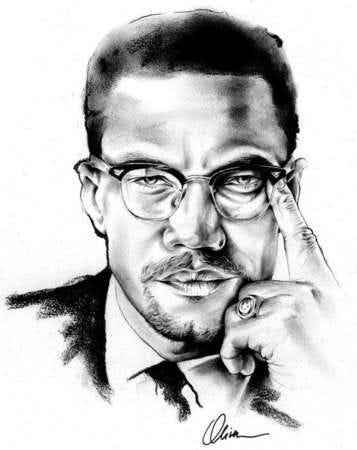
Malcolm X saw the world in black and white, with clear lines between right and wrong, oppressed and oppressor, and truth and lie for most of his early life and time in Harlem. He had learned from his time in America that racism was not merely a social problem, but a deeply rooted system that affected every element of society. His message was strong but also strict by the time he became well known in the Nation of Islam: separation, self defense, and a deep suspicion of white culture. But in 1964, one spiritual journey changed all he thought he understood.
That journey was Hajj.
Malcolm X didn’t go to Mecca as a famous person or a politician. He went as a seeker. What he saw there made him question not just his views on race but also his views on freedom, brotherhood, and what it is to be human. And honestly, he probably didn’t expect it to affect him this much.
Equality in Ihram: The Power of Shared Humanity
One of the most interesting things about Hajj is how simple and fair it is. Everyone who goes on the pilgrimage wears the same simple white clothes called ihram. There are no signs of income, class, or nationality, just millions of individuals standing next to one other and doing the same things. Malcolm had spent years stressing racial separation, so this was more than simply a symbol; it was very personal to him. It’s hard to imagine what that must have felt like.
Malcolm witnessed Muslims of all races. Africans, Arabs, Europeans, Asians. They were praying together, eating together, treating each other as equals. Just… normal. In America, blonde, blue eyed men would have been considered as part of the oppressive system. Now, they were his brothers in religion. This wasn’t just an idea. He was seeing it happen in front of him. That alone says a lot. It’s easy to talk about equality, but seeing it like this is something else. This experience reflected a form of liberty where individuals freely connected beyond race and identity.
Malcolm X’s Letter from Mecca
Malcolm said in a famous letter during his Hajj journey that he had “never before seen sincere and true brotherhood practiced by all colors together, regardless of their race.” This encounter changed the way he thought about things. He had to face a hard truth: racism wasn’t something that white people were born with; it was a disease shaped by institutions, attitudes, and environments.
Scholars have often described this moment as a turning point in Malcolm X’s religious life. In The Autobiography of Malcolm X, Malcolm wrote that during his pilgrimage to the holy city of Mecca in Saudi Arabia, he witnessed the oneness of man in a way he had never experienced before. He described eating with Muslims whose skin was “whiter than white,” yet whose sincerity challenged his earlier views shaped during his time in the Nation of Islam under Elijah Muhammad. According to the Journal of African American Studies, X’s Hajj experience marked a shift from black nationalist separatism toward a broader human rights issue grounded in orthodox Islam. This life-changing spiritual journey led Malcolm Little to adopt the name El-Hajj Malik El-Shabazz and move toward a new direction focused on racial equality, unity among Muslims, and a deeper search for truth. His journey did not erase his commitment to black liberation, but it expanded Malcolm’s worldview, transforming his American story into one of religious and political growth.
A Shift from Racial Struggle to Human Rights
That’s where things began to shift. Malcolm X didn’t stop fighting for justice or speaking out against racism, but he did change the way he did it. He stopped thinking of the struggle as only about race and started to see it as a broader fight for human rights. True Islam, in his Hajj experience, showed him what equality actually looked like in practice and how liberty could exist through voluntary unity.
Finding Peace Through Brotherhood
The change wasn’t just in his thinking. It felt deeper than that. Malcolm may have been at peace for the first time because he was part of something bigger than himself. He wasn’t defined by his history, his anger, or even his activity in Mecca. He was just one of millions of Muslims, all equal in God’s eyes.
A New Understanding of Freedom
This change also influenced how he thought about freedom. Before Hajj, Malcolm thought that freedom meant being free from oppression, especially racial injustice. After Hajj, his understanding grew. Freedom was no longer just about escaping oppression. It also meant letting go of the anger and bitterness that came with it.
Justice Without Division
That doesn’t imply that Malcolm changed his mind about injustice. If anything, his dedication to justice grew more powerful. But it became more deeply connected to a feeling of humanity. He started pushing for racial unity, stressing that real change needed cooperation, not simply conflict.
Nation of Islam and Racial Equality in Practice
His pilgrimage to Mecca also showed how different Islam was from racial relations in America at the time. In Mecca, people were different, but there was no sense of hierarchy. In the United States, diversity often meant separation. This comparison offered Malcolm a strong new point of view that he used in his later speeches and activities.
An Evolution, Not an Overnight Change
It’s important to know that Malcolm didn’t just turn his back on his history overnight. It was more like an evolution. He still spoke out against racism and injustice. But his tone, words, and vision showed a more open and welcoming perspective.
A Legacy That Still Resonates
Sadly, his life was cut short not long after he got back from Hajj. But the effects of his change are still felt. And maybe that’s what makes his story so powerful, it feels real, not perfect. His path shows us that change is possible, even for people who have strong views. It shows that being exposed to new things, having experiences, and thinking about them can unlock doors that might have seemed closed before.
Hajj in as a Journey Toward Freedom
Malcolm X’s Hajj was more than just a religious pilgrimage. It became a journey toward moral and intellectual freedom. It made him reconsider not only how he understood other people, but also how he viewed himself.
Maybe that’s the real takeaway. Sometimes freedom doesn’t come from changing the world. It comes from letting it change you.