


1. Introduction
The linking between Islam, development, and democracy has been a constant and debated topic in comparative politics and the development paradigm. Prominent school of modernization theories always painted this straight line: economic development leads to democratic consolidation, frequently suggesting that religious cultures, particularly Islam, serve as impediments to this trajectory (Lipset, 1959; Huntington, 1996). Recent academic research has contested this form of cultural determinism, illustrating considerable diversity among Muslim-majority societies in terms of political systems and developmental stories (Stepan & Robertson, 2003; Donno & Russett, 2004). Yet, a substantial segment of this discourse continues to be disproportionately focused on the Middle East, resulting in the under-theorization of South Asian Muslim experiences.
Bangladesh is an analytically significant outlier in this study. Even though democracy is still shaky, authoritarianism is on the rise, and institutions are rarely get held to account, the country has made great strides in human development, such as reducing poverty, improving health services, and increasing women’s education and participation in the workforce (Mostofa & Subedi, 2021; World Bank, 2023a; UNDP, 2022). Even with all the political turbulence, the country has attained significant progress in human development metrics (World Bank, 2023a; UNDP, 2022). The coexistence of developmental progress and democratic stagnation really challenges the traditional idea on the essential role of liberal-democratic institutions in fostering social and economic developments.
So, here’s the question this article asks: What insights can Bangladesh teach us about alternative ways to growth and democracy in Muslim-majority countries? It contends that Bangladesh exemplifies how human development can precede—and in specific areas partially replace—liberal-democratic institutions. This has been achieved not chiefly by a robust developmental state, but by a dynamic civil society, comprehensive non-governmental welfare services, and pragmatically negotiated religious norms that embrace social change without secularization. This article adds something new to the fields of comparative politics and development studies by positioning Bangladesh as an analytical case rather than an anomaly. First, it challenges the traditional modernization idea that associates democracy, secularism, and growth. Second, it highlights how much religious values and informal community networks can shape a country’s progress and development. Third, it broadens the empirical and theoretical landscape of debates on Islam and democracy beyond Middle Eastern—focuses and argues the necessity for more contextually attuned strategies for governance and development in Muslim-majority societies.
2. Bangladesh’s Developmental Trajectory: Key Analytical Insights
Bangladesh’s developmental story is analytically significant not for its accomplishments, but for the manner in which it has transpired within a shaky democracy. The country exemplifies a trajectory where human growth progresses not just through strong democratic institutions, but by institutional stability, non-state entities, and deep socially ingrained traditions.
Over the past thirty years, Bangladesh has steadily improved life expectancy, lowered child mortality, enrollment into schools, and pulled millions out of poverty (UNDP, 2022; World Bank, 2023a). These advancements have transpired, while dealing with messy elections, weaker checks and balances, and more power concentrating in the hands of a few. This isn’t really a story of democracy getting stronger. Instead, as many scholars point out, what’s happening is closer to competitive or electoral authoritarianism (Levitsky & Way, 2010). The following Figure 1 illustrates the pattern: the pattern: Human development keeps moving up, but democracy slides back with enduring stagnation and regression.
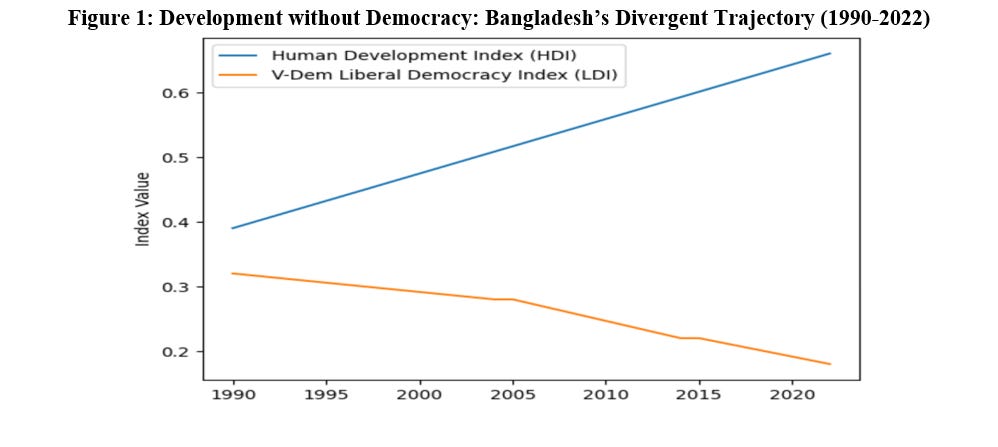
The analytical challenge is to elucidate: why hasn’t development stalled, even with all the political turmoil? A central factor is steady policy continuity across regimes, especially in health, education, family planning, and rural development. All administrations—military, quasi-democratic, and elected—have mostly maintained a technocratic consensus on the fundamental social policies, letting party politics mess with these priorities (Quadir, 2010; Parnini, 2012). So, progress has been propelled more by elite consensus on developmental priorities than by democratic accountability, with the depoliticization of welfare provision. This really challenges the premise that democratic competition is essential for lasting human development (Lipset, 1959).
Another defining characteristic of Bangladesh’s growth model is the pivotal involvement of non-governmental organizations. Prominent NGOs like BRAC and Grameen have not only filled gaps left by a weak state, but also built entire systems for education, healthcare, microfinance, and disaster relief at an unparalleled scale (Kolisetty, 2014). These organizations function not just as service providers, rather they have become institutional alternatives to the government, creating new ways for people and the state to connect. This NGO-led growth is fundamentally tied into a moral economy shaped by Islamic ethics. The practices of zakat, sadaqa, and waqf-inspired charity have aligned with secular development goals, generating a legitimacy that is frequently absent in solely technocratic institutions (Fukuyama, 2001). Instead of undermining religious values, NGOs have often embraced them, framing development in moral terms that align with local religious sensibilities. This confluence elucidates why significant non-state involvement has garnered social acceptance and political viability. Moral legitimacy effectively mitigates institutional deficiencies and inadequate state accountability.
Gender dynamics in Bangladesh really show how flexible social norms can shape real change. The presence of women in the workforce, especially within the garment industry, alongside extensive involvement in microfinance initiatives, has significantly altered household economies and gender role (Kabeer, 2012). These changes have emerged in a Muslim-majority community often presumed to be opposed to women’s participation in public economic jobs. This change signifies pragmatic religious adaptation rather than indicating secularization (Islam & Islam, 2018). In Bangladesh, Islamic standards have been socially negotiated, permitting women’s employment and movement to be rationalized through necessity, family welfare, and moral respectability (Al Mamun & Hoque, 2022). Development has arisen not from leaving religion behind, but from its recontextualization to fit everyday practices. This highlights a broader analytical insight: in Bangladesh, development has advanced through normative flexibility and social compromise rather than doctrinal secularism, confusing strict dichotomies between Islam and modernity.
3. Democracy, Governance, and Informality
Bangladesh’s political trajectory over the last twenty years is most accurately interpreted as competitive authoritarianism, characterized by the coexistence of formal democratic institutions with systematic limitations on political competition. Although elections are conducted routinely, their legitimacy and credibility has increasingly been questioned due to the lack of judicial independence, the weakening of electoral watchdog bodies, restrictions on opposition activity, and the growing concentration of power within the executive (Levitsky & Way, 2010; Riaz, 2020). Consequently, the nuts and bolts of democracy in Bangladesh have worn down over time, even though the rituals of elections are still there.
Despite institutions falling apart, the country hasn’t collapsed into chaos or lost its grip on politics. Instead, governance has been maintained through a web of informal network, such as patron-client relationships, party-oriented resource allocation, and individualized power structures. Political loyalty is frequently rewarded with jobs, social welfare benefits, or protection, whereas disagreement may lead to expulsion from these networks (Khan, 2013). Such arrangements substitute impersonal rule-based governance and contribute to a measure of political stability in the absence of robust institutions. Nevertheless, they also reinforce elite supremacy and restrict substantial opportunities for citizen accountability.
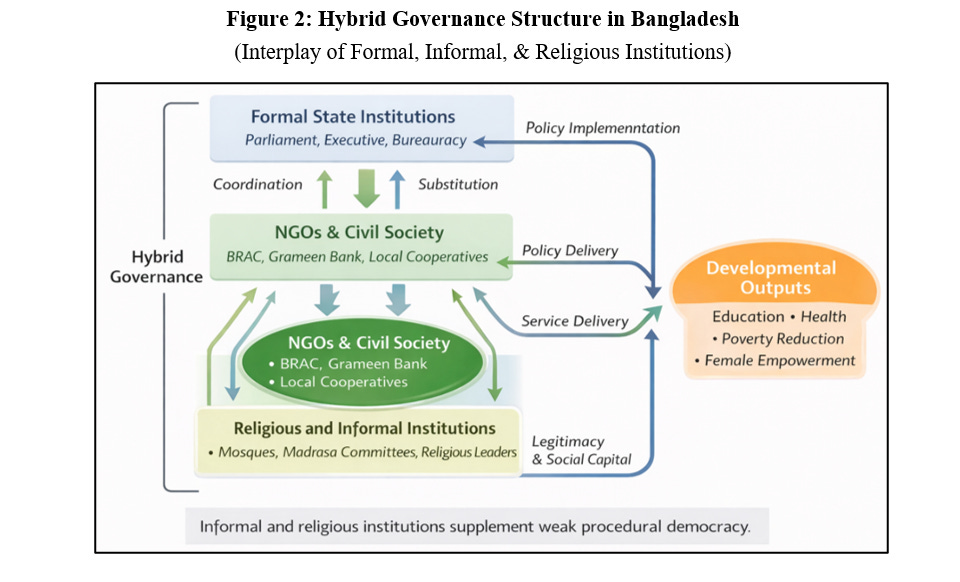
In these informal government settings, moral authority plays a vital role in legitimizing function. Politicians lean on religious symbols, moral language, and promises of stability to shore up their own authority, especially at the local level. Mosques and madrasas aren’t just places for prayer or study; they double as hubs for settling disputes, helping with welfare, and keeping the community running smoothly (Wood, 2007). Religious leaders frequently serve as middlemen between the populace and the government, converting bureaucratic power into comprehensible moral language. This mediation is particularly crucial in rural regions, where the state barely shows up and people don’t put much faith in official institutions. Instead of serving as a substitute for the state, these religious and informal entities are intricately intertwined with it. Local politicians build ties with mosque committees, madrasa administrators, and religious figures to boost their own influence, motivate voters, and keep society in check (Riaz & Fair, 2010). The lines between government and informal power get blurry, resulting in a hybrid political system whose legitimacy comes from both moral authority and official, legal institutions.
The primary analytical conflict, however, lies in the political ramifications of this informality. Although informal networks and religious mediation can enhance governance by settling disputes, allocating resources, and compensating for ineffective institutions, they also chip away at democracy. Decision-making becomes unclear, rule enforcement becomes discretionary, and political participation depends on allegiance rather than entitlements. Citizens interact with the state not as individuals possessing rights, but as clients situated inside hierarchical social structures. Bangladesh’s example demonstrates that informality can keep the system working for a while, but in the long run, it hinders real democratic progress, and keeps things stable for those in power, instead of holding them accountable.
Comparative Insights and Theoretical Implications
The development and governance trajectory of Bangladesh becomes clearer when analyzed comparatively. It demonstrates how Muslim-majority societies uniquely navigate the relationship among Islam, development, and democracy.
Bangladesh vs. Pakistan
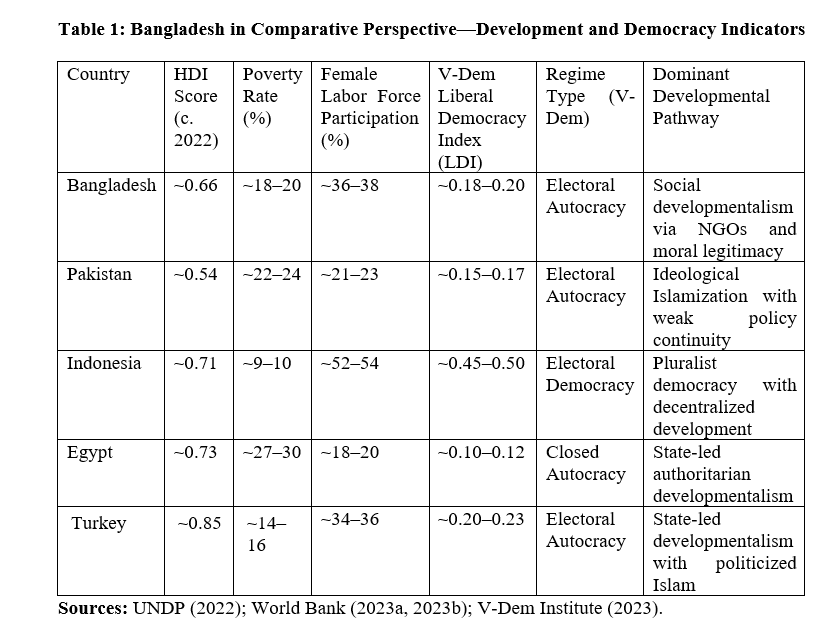
In Bangladesh, people turn to Islam more as a part of daily life and community than as a strict political agenda. Religious norms and institutions—mosques, madrasas, and zakat practices—have been effectively incorporated into development projects, gender programs, and local administration. This weaves religion into the fabric of society, strengthening community ties and giving a boost to non-government groups that help people out (Fukuyama, 2001; Wood, 2007). The state has predominantly permitted religious heterogeneity and local negotiation of Islamic values, fostering policy continuity and gradual societal change even within a framework of competitive authoritarianism.
Pakistan’s history tells a different. Here, Islam hasn’t just been a source of values—it’s been used as a centralized ideological tool for state formation. Since the Objectives Resolution of 1949 (Constituent Assembly of Pakistan, 1949), the state has endeavored to weave Islamic principles into the country’s laws and government through various Islamization initiatives under military regimes, frequently undermining political plurality and institutional stability (Gurchani, Imran, & Malik, 2024; Nasr, 2000; Lieven, 2011). This top-down instrumentalization of Islam has constrained development policy by privileging ideological conformity over pragmatic social programming. The contrast illustrates that the role of Islam in governance—resource versus ideological mandate—significantly shapes the capacity of Muslim-majority societies to achieve developmental outcomes alongside, or independent of, democratic consolidation.
Bangladesh vs. Indonesia
Indonesia offers a different perspective for comprehending the importance of institutional design. Unlike Bangladesh, which sticks with a more centralized framework, Indonesia’s post-Suharto decentralization has enhanced the authority of subnational administrations, resulting in varied approaches to policy execution and democratic engagement (Hadiz & Robison, 2005). Decentralization boosted local accountability and made the democratic process more meaningful.
Still, it sometimes hindered the consistent execution of development initiatives, so there’s a clear trade-off: more inclusive governance, but less consistency in following through on big projects (Anwar, 2019). Conversely, Bangladesh has leaned on a centralized system and utilized elite consensus to maintain cohesive human development policies despite fragile democratic institutions.
Bangladesh vs. Egypt
The comparison between Bangladesh and Egypt elucidates how divergent governmental approaches to religion and civil society shape development and democratic outcomes in Muslim-majority societies. Despite both countries exhibit weak democracy and authoritarian habits, their developmental trajectories significantly differ in institutional structure and legitimacy sources. In Bangladesh, development has progressed through social developmentalism, significantly contributed by non-state actors, consistent policy implementation, and the pragmatic integration of Islamic principles in welfare provision. Religious institutions and ethical practices, like mosque-based social mediation, serve as socially ingrained resources that bolster the legitimacy of NGO-led and community-based development initiatives (Fukuyama, 2001; Wood, 2007). Instead of being dominated by the state, religious authority is negotiated, allowing Islam to function as a flexible moral framework that fosters gradual societal change and ongoing human development, even in the context of competitive authoritarianism (Lewis, 2012).
In contrast, Egypt represents authoritarian developmental statism, marked by consolidated governmental control over economic policies, welfare assistance, and religious organizations. Religious authority is bureaucratized and subordinated to the state through entities like al-Azhar and the Ministry of Religious Endowments, constraining the autonomy of religious actors and civil society (Brown, 2017; Moustafa, 2014). Despite large-scale infrastructural and macroeconomic initiatives, Egypt has struggled to achieve inclusive human development outcomes compared to Bangladesh, particularly in education quality, gender inclusion, and social mobility (UNDP, 2022; World Bank, 2023b).
Bangladesh vs. Turkey
A comparison between Bangladesh and Turkey really shows how much state power and the way religion is built into institutions shape both development and democracy. Both countries have a kind of competitive or electoral authoritarianism, but they take very different paths when it comes to weaving Islam into government and development frameworks. In Bangladesh, Islam is predominantly detached from official state ideology, serving primarily as a cultural and social resource integrated into daily routines, welfare distribution, and local administration. Developmental gains have been driven by NGO-led services, informal networks, and elite agreement on fundamental social policies, rather than by a robust, centralized state government (Quadir, 2010; Parnini, 2012; Kolisetty, 2014). Religious norms have been pragmatically adapted to facilitate women’s involvement in labor, education, and social mobility, enabling development without ideological secularization or formal democratic enhancement (Kabeer, 2012; Al Mamun & Hoque, 2022).
Turkey, in contrast, integrates robust state institutions with the political instrumentalization of Islam. Turkey’s historical trajectory, influenced by a centralized bureaucratic culture, has been primarily state-driven, with Islam progressively integrated into governance via electoral mobilization and party politics, rather than through informal social mediation unlike Bangladesh (Keyman, 2014). Under competitive authoritarianism, religious legitimacy has been employed to consolidate executive authority, reform public institutions, and marginalize opposition, thereby contributing to democratic backsliding despite sustained economic and infrastructural development (Levitsky & Way, 2010; Esen & Gümüşçü, 2016). In contrast to Bangladesh’s decentralized religious authority, Islam in Turkey has become more closely integrated with governmental power, so constraining its function as an independent source of social capital.
This comparative analysis signifies that neither state power nor authoritarian rule alone determines developmental outcomes in Muslim-majority countries. Bangladesh exemplifies how socially ingrained religion can offset deficient formal institutions, facilitating human growth via negotiated and community-driven religious practices. In contrast, Turkey and more notably Egypt, exemplify how the institutionalization of religion inside a robust state may coexist with economic advancement while eroding democratic pluralism. These disparities underscore that the political and developmental impacts of Islam are influenced more by institutional setting and governance methods than by dogma. The following Table 2 delineates the types of developmental governance in Muslim-majority countries, emphasizing how differences in state capability, civil society involvement, and the political influence of Islam all shape the varied development-democracy configurations.
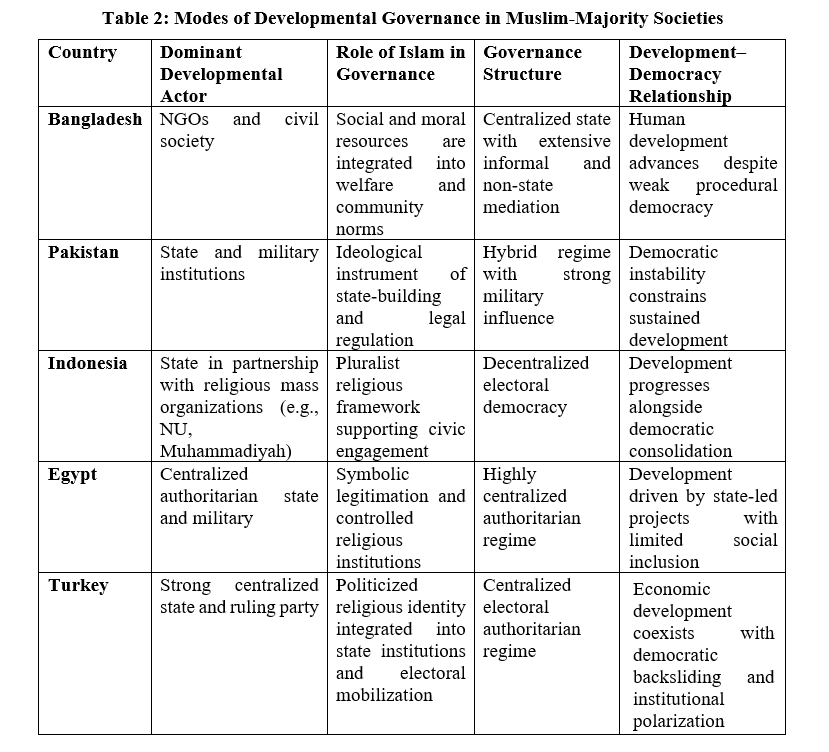
These comparisons also underscore the overarching theoretical understanding that Muslim-majority states do not adhere to a singular, deterministic course from Islam to democracy or development. Instead, they demonstrate multiple modernities, wherein institutional frameworks, state strategies, and religious-social norms interact in context-specific manners. Bangladesh exemplifies a developmental paradigm wherein Islam functions as a legitimizing and adaptive resource, centralized authority ensures policy consistency, and civil society mitigates inadequate democratic structures. Comparative analysis, thus, challenges uniform assumptions on Muslim politics and underscores the importance of context-specific frameworks for comprehending the diversity of political and developmental outcomes.
5. Core Lessons and Implications
The analysis of Bangladesh’s development and governance trajectory reveals several critical lessons with both empirical and theoretical relevance for comparative politics and development studies. Firstly, Bangladesh exemplifies that development does not require prior democratic consolidation. Contrary to linear modernization theories, which assert that economic growth and human development inherently accompany democratic institutionalization (Lipset, 1959; Inglehart & Welzel, 2005; Ciftci, 2010). Even with shaky democratic institutions and deficient institutional accountability, Bangladesh has achieved significant advancements in health, education, and poverty alleviation (UNDP, 2022; World Bank, 2023a). Policy continuity, elite consensus, and technical execution have guaranteed that developmental can advance even when democratic mechanisms remain fragile or performative.
Second, the Bangladeshi experience challenges the presumption that Islam intrinsically impedes development. Instead, Islam can serve as a developmental facilitator by offering moral legitimacy, fostering social solidarity, and establishing normative frameworks for welfare distribution. The incorporation of religiously motivated principles—such as zakat and waqf—into NGO-led and community-oriented development programs has facilitated widespread societal acceptability and cultural relevance, hence augmenting their efficacy (Fukuyama, 2001; Wood, 2007). Islamic social capital can be pragmatically utilized to facilitate development, especially in environments with constrained formal state capability, rather than acting as a hindrance to modernization.
Third, Bangladesh exemplifies how civil society can substitute for weak state institutions, facilitating governance and providing public goods in sectors such as health, education, and microfinance. NGOs such as BRAC and Grameen Bank have emerged as quasi-institutional entities, connecting the state with local communities and cultivating social trust. This paradigm enhances developmental outcomes but involves democratic compromises. Dependence on informal governance networks and religiously legitimated moral authority can bypass official accountability mechanisms, so entrenching elite supremacy and limiting citizen engagement in decision-making (Levitsky & Way, 2010; Riaz & Fair, 2010).
These discoveries collectively suggest a deeper theoretical implication: the comparative analysis of Muslim-majority states necessitates moving beyond normative prescriptions for democracy and liberal institutions. Instead of supposing that democratic consolidation is a prerequisite for human development, scholars and policymakers ought to embrace a contextual governance approach, focusing on the interplay of local institutions, religious norms, and civil society in generating particular developmental outcomes. Bangladesh exemplifies an alternative modernity where human development, social stability, and practical religiosity coexist, demonstrating that institutional design, policy continuity, and social integration are as essential as formal democratic processes in influencing societal advancement.
*Professor Dr. Md. Thowhidul Islam
Center for General Education
International Islamic University Chittagong
Bangladesh-4318. Cell: +88-01817078263
E-mail: tauhidcox@gmail.com; tauhidcox@iiuc.ac.bd.
Scopus ID: 57208297573 I ORCID ID: 0000-0002-2407-8422
Web of Science Researcher ID: ACL-8228-2022
References
Anwar, D. F. (2019). Indonesia’s democratization underpinned by major Islamic groups and consensus on national ideology. Middle East Institute. https://mei.edu/publication/indonesias-democratization-underpinned/.
Brown, N. J. (2017). Egypt’s judges in a revolutionary age. Cambridge University Press. Retrieved from https://carnegieendowment.org/research/2012/02/egypts-judges-in-a-revolutionary-age
Ciftci, S. (2010). Modernization, Islam, or Social Capital: What Explains Attitudes Toward Democracy in the Muslim World? Comparative Political Studies, 43(11), 1442-1470. https://doi.org/10.1177/0010414010371903
Donno, D., & Russett, B. (2004). Islam, authoritarianism, and female empowerment: What explains women’s political status in Muslim-majority states? World Politics, 56(4), 582–607. https://doi.org/10.1353/wp.2005.0008
Esen, B., & Gümüşçü, Ş. (2016). Rising competitive authoritarianism in Turkey. Third World Quarterly, 37(9), 1581–1606. https://doi.org/10.1080/01436597.2015.1135732
Fukuyama, F. (2001). Social capital, civil society and development. Third World Quarterly, 22(1), 7–20. https://doi.org/10.1080/713701144
Gurchani, S., Imran, T., & Malik, U. (2024). The role of Islam in shaping Pakistan’s political identity and governance. Global Social Sciences Review, IX(IV), 135–144. https://doi.org/10.31703/gssr.2024(IX-IV).14
Huntington, S. P. (1996). The clash of civilizations and the remaking of world order. Simon & Schuster. https://www.simonandschuster.com/books/The-Clash-of-Civilizations-and-the-Remaking-of-World-Order/Samuel-P-Huntington/9781451628975
Inglehart, R., & Welzel, C. (2005). Modernization, cultural change, and democracy: The human development sequence. Cambridge University Press.
https://doi.org/10.1017/CBO9780511790881
Islam, M. N., & Islam, M. S. (2018). Islam, Politics and Secularism in Bangladesh: Contesting the Dominant Narratives. Social Sciences, 7(3), 37. https://doi.org/10.3390/socsci7030037
Kabeer, N (2012). Women’s economic empowerment and inclusive growth: labour markets and enterprise development. Discussion Paper No. 29. Centre for Development Policy & Research, School of Oriental & African Studies, University of London. https://gsdrc.org/document-library/womens-economic-empowerment-and-inclusive-growth-labour-markets-and-enterprise-development/
Keyman, E. F. (2014). The AK Party: Dominant party, new Turkey and polarization. Insight Turkey, 16(2), 19–31. https://www.insightturkey.com/commentaries/the-ak-party-dominant-party-new-turkey-and-polarization-1-1
Kolisetty, A. (2014). Examining the effectiveness of legal empowerment as a pathway out of poverty: A case study of BRAC (Justice & Development Working Paper No. 26/2014). The World Bank. https://documents1.worldbank.org/curated/en/937901468006879727/pdf/846620NWP0Web00y0Box382143B00PUBLC0.pdf
Levitsky, S., & Way, L. A. (2010). Competitive authoritarianism: Hybrid regimes after the Cold War. Cambridge University Press.
https://doi.org/10.1017/CBO9780511781353
Lewis, D. (2012). Bangladesh: Politics, economy and civil society. Cambridge University Press.
https://doi.org/10.1017/CBO9781139017138
Lipset, S. M. (1959). Some social requisites of democracy: Economic development and political legitimacy. American Political Science Review, 53(1), 69–105. https://doi.org/10.2307/1951731
Mostofa, S.M. and Subedi, D.B. (2021) ‘Rise of Competitive Authoritarianism in Bangladesh’, Politics and Religion, 14(3), 431–459. https://doi.org/10.1017/S1755048320000401.
Moustafa, T. (2014). Law and courts in authoritarian regimes. Annual Review of Law and Social Science, 10, 281–297. https://doi.org/10.1146/annurev-lawsocsci-110413-030532
Al Mamun, M. A., & Hoque, M. (2022). The impact of paid employment on women’s empowerment: A case study of female garment workers in Bangladesh. World Development Sustainability, 1, 100026. https://doi.org/10.1016/j.wds.2022.100026
Constituent Assembly of Pakistan (1949). Objectives Resolution. https://na.gov.pk/uploads/documents/1434604343_885.pdf.
Parnini, S. N. (2012, April 13). Consolidating democracy in Bangladesh. East Asia Forum. https://eastasiaforum.org/2012/04/13/consolidating-democracy-in-bangladesh/
Quadir, F. (2010). Consolidating Democracy without Trust: Bangladesh’s Breakdown of Consensus in 2007. The Round Table, 99(406), 65–73. https://doi.org/10.1080/00358530903513731
Riaz, A., & Fair, C.C. (Eds.). (2010). Political Islam and Governance in Bangladesh (1st ed.). Routledge. https://doi.org/10.4324/9780203845301
Stepan, A., & Robertson, G. (2003). An “Arab” more than a “Muslim” democracy gap. Journal of Democracy, 14(3), 30–44. https://www.journalofdemocracy.org/articles/an-arab-more-than-muslim-democracy-gap/
UNDP. (2022). Human Development Report 2022: Uncertain times, unsettled lives — Shaping our future in a transforming world. United Nations Development Programme. https://hdr.undp.org/content/human-development-report-2021-22
V-Dem Institute. (2023). Varieties of Democracy (V-Dem) dataset v13. University of Gothenburg.
https://www.v-dem.net
Wood, G.D. (2007). Clashing Values in Bangladesh: NGOs, Secularism and the Ummah’ Wellbeing in Developing Countries (WeD). Working Papers, no. 31, ESRC Research Group on Wellbeing in Developing Countries, Bath.
World Bank. (2018). Bangladesh: Reducing poverty and sharing prosperity. World Bank. https://www.worldbank.org/en/results/2018/11/15/bangladesh-reducing-poverty-and-sharing-prosperity
World Bank. (2023a). Bangladesh country profile: Development indicators. World Bank DataBank. https://data.worldbank.org/country/bangladesh
World Bank. (2023b). World development indicators. World Bank. https://databank.worldbank.org/source/world-development-indicators