

A punishment can be procedurally lawful and still raise questions about whether the court delivering it is acting within its proper bounds. Jordan’s recent executions are a case in point. On June 21, Jordan executed six men convicted by its State Security Court (SSC), a military tribunal whose jurisdiction has shifted by amendment over the decades, ending a nine-year hiatus on capital punishment.
The six men executed included Mahmoud Nayef Musa, Anwar Adel Saleh, Ibrahim Mansour, and three others. Musa and Saleh were convicted in connection with the 2018 Salt Cell attack on security forces; Mansour was executed for his role in an ambush on a police patrol in 2022; the remaining three were executed for their involvement in the killing of law enforcement officers during anti-narcotics operations.
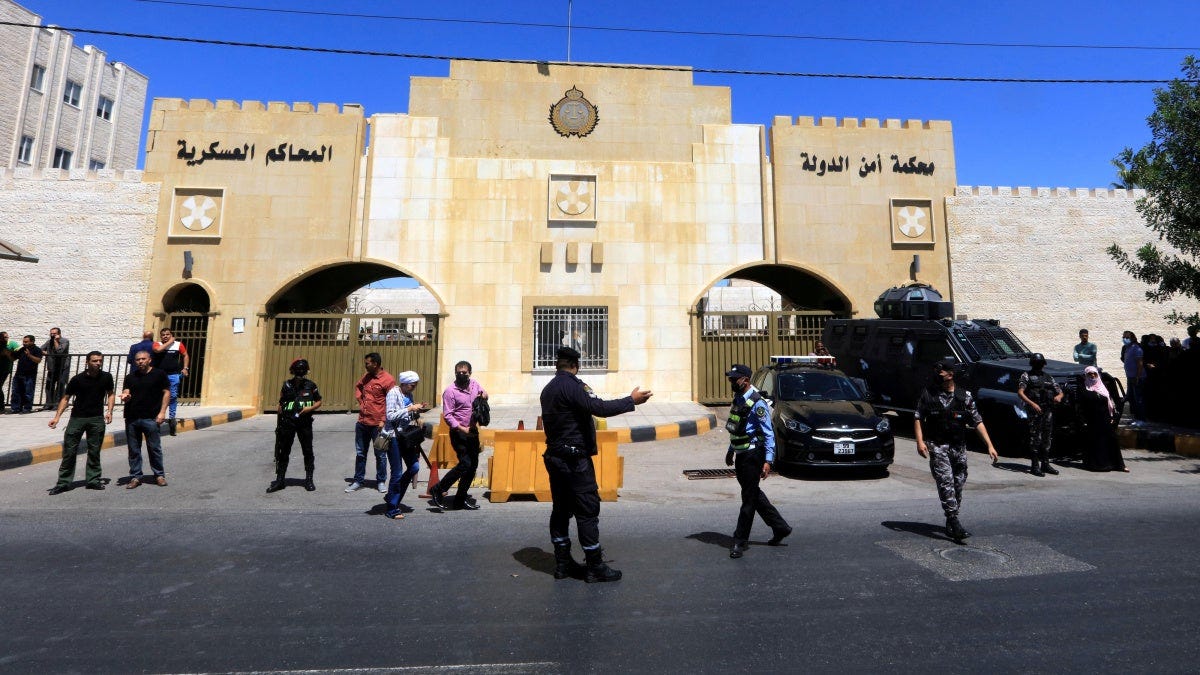
Government Spokesperson Mohammad al-Momani confirmed the executions were carried out after sentences received confirmation by the Court of Cassation, Cabinet endorsement, and royal decree, in accordance with Article 359 of the Code of Criminal Procedure. The Jordanian government framed the executions as justice for fallen security personnel. Jordan had previously resumed executions in December 2014 after an eight-year pause, which Human Rights Watch described as “backsliding on human rights.”
The State Security Court, established under Law No. 17 of 1959, is a military tribunal with jurisdiction over civilians in five categories under the 2011 constitutional amendments to Article 101: grand treason, espionage, terrorism, drug offences, and currency fraud. The Court’s founding statute additionally grants the Prime Minister discretionary authority to refer any crime deemed connected to economic security to the SSC under Article 3(a)(3) of Law No. 17 of 1959.
Jordan’s resumption of capital punishment carries broader implications. On the same day as the executions, Prime Minister Jafar Hassan announced plans to expand the scope of the death penalty to cover major drug traffickers and smugglers operating in coordination with external criminal networks, all while placing further pressure on the SSC’s already broad jurisdiction. This sits alongside Jordan’s obligations under the International Covenant on Civil and Political Rights, ratified in 1975, whose Article 6(2) restricts the death penalty to the “most serious crimes” only. The Human Rights Committee, in General Comment No. 36, has explicitly stated that drug offences cannot serve as the basis for capital punishment under this threshold. Official figures on Jordan’s death-row population vary significantly; the National Centre for Human Rights recorded 276 individuals under sentence of death in 2024, Amnesty International reported at least 200 as of December 2025, and Government Spokesperson Momani stated that more than 100 prisoners remain on death row.
Jordan’s executions intersect with longstanding global debates on capital punishment. Human Rights Watch has reiterated its opposition to the use of military courts to try security-related offences, arguing that such courts are frequently authorised to conduct trials in ways that restrict defendant rights beyond what international human rights law permits. Adam Coogle, deputy Middle East director at Human Rights Watch, called on Jordan to renew its moratorium on the death penalty. The United Nations General Assembly similarly called on states in 2012 to establish a moratorium on executions, progressively restrict the practice, and reduce the offences for which it may be imposed. Relative to its neighbours, Jordan has used capital punishment sparingly, imposing at least 31 death sentences over the last five years compared to at least 2,341 in Egypt and 549 in Iraq over the same period, making Hassan’s announced expansion of its application a notable departure from that pattern.
Yet, Jordan’s executions raise a structural question that extends beyond the cases themselves. How does a court established for state security offences come to execute people for drug offences, with active plans to expand that further? At the same time, bound by a treaty its government voluntarily joined in 1975?