

Abstract
What determines the gap between wealth and poverty in modern societies? New Institutional Economics (NIE) seeks the answer to this question not in geography or culture, but in institutions. Property rights, the rule of law, and the limitation of arbitrary rule are the engines of development. Does the economic heritage of the Islamic world contradict these modern concepts? This study argues that Islam’s founding economic values are actually surprisingly consistent with the modern institutional economics’ definition of inclusive institutions. The reason for the backwardness in the Islamic world is not religion itself, but institutional inertia and the ossification of mindsets throughout history. Rediscovering this lost heritage could be a way forward for Muslim societies.
1. Why Are Institutions Important?
Perhaps it is appropriate to begin directly with the example of the Prophet. When Muhammad (peace be upon him) was asked to fix prices (set a price ceiling) in response to price increases, he refused to intervene in the market, saying, “It is Allah who determines prices.” This is one of the earliest and strongest defences of a free market economy.[1] This approach aligns with the idea of “spontaneous order” advocated by institutional economics and liberal thought.[2] The similarities between Islam’s understanding of the market and Adam Smith’s “Invisible Hand” theory, which developed a year later, are quite striking.
Islam views the market as a competitive arena governed by fair rules. However, over time, the “traditional mindset” and Sufism’s concept of “contentment” have diminished the motivation to pursue sustenance, leading to a loss of competitive dynamism.[3] This article aims to offer a new perspective on regaining the dynamism we have discussed.
One of the most significant paradigms in economics over the past twenty years has been the acceptance of the central role of institutions in development, rather than geography or culture. The “Reversal of Fortune” thesis developed by Acemoğlu, Johnson and Robinson[4] explains why regions that were rich in 1500 are poor today, while those that were relatively backward at the time are rich today, by the difference between the “extractive” and “inclusive” institutions established during the colonial period.
The claim of institutional economists is simple: sustainable growth is impossible in societies where property rights are not protected, contracts are not enforced by impartial courts, and executive power is arbitrary.[5]
On the other hand, studies on the economic performance of the Islamic world often question the relationship between “Islam and Development”. The fundamental debate in the literature is whether Islam inherently carries values that hinder economic development. However, the works of scholars such as Acar, Koehler, Akyol, Sanandaji, Salman, and Kanbir[6] have demonstrated that Islam built a commercial civilisation in its early days based on individual freedom, commercial ethics, and the rule of law. This article aims to reveal the theoretical similarities between Islam’s normative economic understanding and the structures that institutional economics today characterises as inclusive institutions.
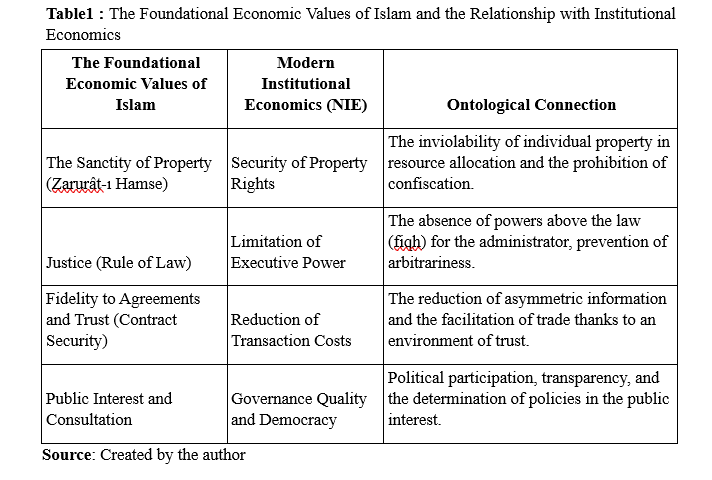
The table above summarises how Islam’s fundamental economic approach aligns with institutional economics. These relationships are particularly evident in fundamental areas such as property rights, the rule of law, contract security and governance quality.
2. Property Rights: A Sacred Domain
The cornerstone of New Institutional Economics is the security of property rights. Property rights institutions minimise the risk of the state or elites seizing individuals’ assets. [7] When examining Islamic economic doctrine, the sanctity and inviolability of property is a fundamental principle. The Prophet Muhammad (peace be upon him) stated in his farewell sermon that your property and your lives are inviolable.[8] In classical fiqh tradition, property is considered one of the Five Necessities (Zarurât-ı Hamse) and is held at the same level as the safety of life and mind.[9] The protection of property in Islamic law is a guarantee of the individual’s autonomy vis-à-vis the state.
However, as Timur Kuran states in “The Long Divergence”[10], theory and practice have diverged over time. The waqf system, developed in the Islamic world to protect property from the risk of arbitrary seizure (müsadere) by the state, has gradually become a trap. Capital was frozen through waqfs, which blocked the way for modern models of incorporation and capital accumulation.[11]
Nevertheless, within the normative framework, Islam’s vision of property rights directly aligns with the idea of creating a secure private sphere that individuals can use for their own purposes, as advocated by Hayek in his Constitution of Liberty.[12] It is no coincidence that property security ranks high in Islamic development indices.[13]
3. Rule of Law and Limited Government
Institutional economics argues that a strong legal system is only possible with “constraints on the executive”. If the ruler or executive body is above the law, investors cannot be assured that their property will be protected in the future.[14]
Islamic political theory is based on the supremacy of law (sharia). As emphasised by Akyol[15] and Khuri[16], in the classical Islamic state, the caliph is not a legislator but an enforcer of the law. The class that produces the law (fiqh) is the ulema, who are civil and independent. This structure is akin to an early form of the principle of “separation of powers” in institutional economics. The fact that governance is based on the principle of “Shura” (consultation) and the accountability of the ruler parallels the political inclusiveness necessary for the development of democratic institutions.[17]
Unfortunately, throughout history, authoritarian tendencies have suppressed this liberal streak, particularly with the closure of the Muslim mind.[18] The political authority’s increased control over the law has narrowed the horizons of economic actors; long-term investments have been replaced by short-term rent-seeking activities associated with the state.
4. Trust Society and Low Costs
As defined by Nobel Prize-winning economist Douglass North, institutions are rules that reduce transaction costs in a society.[19] The ability of strangers to trade with confidence is the key to development.
Islamic economic ethics are based on the legacy of a Prophet known as “Al-Amin” (the Trustworthy). As Ülgener states in his work “Mentality and Religion,” early Islamic ethics had a dynamic structure that viewed worldly work and honest trade as a form of worship.[20] Rules such as contractual fidelity (ahde vefa), honesty in measurement and weighing, and the prohibition of deception (garar prohibition) are moral and legal barriers aimed at solving the “asymmetric information” problem in modern economics.[21]
The medieval Islamic world developed complex contractual forms such as “Mudaraba,” considered the precursor to modern partnerships. These institutional innovations reduced transaction costs, enabling Muslim merchants to dominate global trade for centuries.[22]
5. Maslahat, Shura, and Governance
In institutional economics literature, the parallels between inclusive political institutions and the principles of Shura and Maslahat in Islamic political and legal thought represent a system of checks and balances. Shura and participation emerge as an open, transparent, and participatory approach. It is possible to relate this concept to political participation and electoral process criteria in modern democracy indices as a principle, value, and peaceful transfer of power.[23] The concepts of Maslahat and Shura are reflections of the principles of governance quality and accountability in Islamic thought. The principle of Maslahat-ı Amme (Public Interest) in Islamic law corresponds to the concepts of “Social Welfare Function” and “Efficient Resource Allocation” in modern economics. This principle advocates that institutions should be designed for the benefit of the general public, not just a narrow elite (inclusive institutions).
6. Institutional Inertia: Where Did We Go Wrong?
If the fundamental values of Islam are so compatible with institutional economics, why have Muslim societies lagged behind? Timur Kuran answers this question with institutional inertia.[24] According to Kuran, the problem lies not in the spirit of Islam, but in its institutional forms, which have remained unchanged over time. Inheritance law has prevented the establishment of large enterprises (companies) by causing the fragmentation of capital. The lack of legal personality is the second important reason. While universities, churches and companies gained legal personality in the West, foundations in the Islamic world remained individual institutions, making it difficult for independent centres of power to emerge in the face of political authority. The Foundation System, by locking resources to specific purposes (static structure), has prevented the allocation of resources according to the changing needs of the market. This analysis of the Qur’an coincides exactly with Acemoğlu’s institutional economics perspective. When institutions fail to adapt to changing economic conditions, that society falls into an institutional trap.[25]
According to Kanbir and Acar’s analyses, the backwardness in the Muslim world has deepened with the shift from a rational (like Mu’tazili) line to a traditionalist and fatalistic line. External shocks such as the Crusades, Mongol invasions, and colonialism have also reinforced this internal stagnation.[26]
7. Conclusion: Building the Future with the Legacy of the Past
The analyses presented in this study show that economic backwardness in the Islamic world is not a theological necessity but a historical and institutional “accident.” When examining Islam’s founding texts and early practices, a surprising alignment with the “inclusive institutions” advocated by modern New Institutional Economics theory is observed. Principles such as the sanctity of property (private property rights), fidelity to agreements (contractual security), avoidance of market intervention (free market), and the rule of law are present in the DNA of Islamic economics. Therefore, the crisis experienced by Muslim societies today stems not from religion itself, but from the suppression of these dynamic principles under rigid traditions and authoritarian political structures over time.
The “institutional inertia” experienced throughout history has been the greatest handicap of the Islamic world. While the Western world encouraged capital accumulation and innovation through institutional innovations such as legal personality, anonymous companies and independent judiciary, the Islamic world became trapped within structures that once provided solutions, such as the waqf system, and failed to evolve them according to modern needs. As Sabri Ülgener accurately observed, the inward-looking mindset and departure from rational thinking in the “world of ideas” have led to the rusting of economic mechanisms.
Today, the way forward for the Islamic world lies neither in blindly imitating Western institutions by severing them from their historical context (import substitution institutionalisation) nor in a nostalgic return to the archaic structures of the past. The real issue is to be able to synthesise the principles of “justice” and “freedom” inherent in Islam with the institutional forms of the 21st century (transparent governance, digital law, democratic oversight).
Amartya Sen’s thesis that “development is a process of liberation” is also a vital compass for Muslim societies. In an environment where individual freedom of enterprise is restricted, property is at the mercy of the state, and the law offers no guarantees, neither Islamic nor secular development can be discussed. Economic prosperity will only come when a “trust society” is built where individuals can freely display their talents.
Ultimately, Islam’s lost key lies deep within the Muslim mind, perhaps gathering dust on forgotten shelves. That key is an institutional architecture that places law above politics, instils confidence in labour and capital, and encourages critical thinking. The rediscovery of this heritage and its updating with modern norms will be a major gain not only for the prosperity of the Muslim world but also for the balance and diversity of the global economic system.
About the Author:
Associate Professor, Giresun University, Department of Dereli Vocational School, ORCID: 0000-0001-5696-4077,ozgur.kanbir@giresun.edu.tr , Giresun, Turkey
References:
Özgür Kanbir, The Political Economy of Economic Development and Development Problems in The Islamic Worlds (Bursa, Turkey: Sayda, 2024), https://doi.org/10.5281/zenodo.17526603.
Milton Friedman, Capitalism and Freedom (London: University of Chicago Press, 2002); Friedrich Von Hayek, The Constitution of Liberty (London: The University of Chicago Press, 2011).
S. Ülgener, Mentality, Intellectuals and Isms (Istanbul: Derin Publications, 2006).
Daron Acemoglu, Simon Johnson, and James A. Robinson, “Reversal of Fortune: Geography and Institutions in the Making of the Modern World Income Distribution,” Quarterly Journal of Economics 117, no. 4 (2002): 1231–94, https://doi.org/10.1162/003355302320935025.
Daron Acemoglu, “Oligarchic versus Democratic Societies,” Journal of the European Economic Association 6, no. 1 (2008): 1–44, https://doi.org/10.1162/JEEA.2008.6.1.1; S. Knack and P. Keefer, “Institutions and Economic Performance: Cross‐country Tests Using Alternative Institutional Measure,” Economics & Politics 7, no. 3 (1995): 207–27.
M. Acar, “Reason versus Tradition, Free Will Versus Fate, Interpretation Versus Literalism: Intellectual Underpinnings of the Negative Outlook for the Muslim World,” in Islamic Foundations of a Free Society, ed. N El Harmouzi and L Whetstone (London: The Institute of Economic Affairs, 2016), 33–57; Benedikt Koehler, Early Islam and The Birth of Capitalism (Maryland: Lexington Books, 2014); Mustafa Akyol, Islam Without Extremes, 2011; Nima Sanandaji, The Birthplace of Capitalism: The Middle East (Livonia: Timbro, 2018); Ali Salman, Islam and Economics: A Primer on Markets, Morality and Justice (Malaysia: Strategic Information and Research Development Centre, 2024); Kanbir, The Political Economy of Economic Development and Development Problems in the Islamic Worlds.
Daron Acemoglu and Simon Johnson, “Unbundling Institutions,” Journal of Political Economy 113, no. 5 (2005): 949–95, https://doi.org/10.1086/432166.
B Erul, “Farewell Sermon,” TDV Islamic Encyclopaedia 42 (2012): 591–93.
Ertuğrul Boynukalın, “Makāsıdü’ş-Şerîa,” in Islamic Encyclopaedia (Turkey Religious Affairs Foundation, 2003).
T Kuran, The Long Divergence: How Islamic Law Held Back the Middle East, the United Kingdom (Princeton University Press, 2011).
Kuran; Magda Ismail Abdel Mohsin et al., Financing the Development of Old Waqf Properties: Classical Principles and Innovative Practices around the World (Malaysia: Palgrave Macmillan, 2016), https://doi.org/DOI 10.1057/978-1-137-58128-0.
Hayek, The Constitution of Liberty.
Özgür Kanbir and Mehmet Dikkaya, “Islamic Development Index,” Sosyoekonomi 29, no. March 2020 (2021): 151–80, https://doi.org/10.17233/sosyoekonomi.2021.03.08.
Andrea F. Presbitero, “Institutions and Geography as Sources of Economic Development,” Journal of International Development 18, no. 3 (2006): 351–78, https://doi.org/10.1002/jid.1225.
Akyol, Islam Without Extremes.
Richard K. Khuri, Freedom, Modernity, and Islam: Toward a Creative Synthesis (USA: Syracuse University Press, 1998), https://doi.org/10.35632/ajis.v15i3.2164.
M.H. Kamali, Freedom, Equality and Justice in Islam (Cambridge UK: The Islamic Texts Society, 2002).
R. R. Reilly, The Closing of the Muslim Mind: How Intellectual Suicide Created the Modern Islamist Crisis. (Wilmington, Delaware: ISI Books, 2023).
North Douglass, Institutions, Institutional Change and Economic Performance (Cambridge University Press, 1990).
S Ülgener, Mindset and Religion: Islam, Sufism and the Economic Ethics of the Dissolution Period (Istanbul: Derin Yayınları, 2006).
Kanbir, The Political Economy of Economic Development and Development Problems in The Islamic Worlds.
Imad-ad-dean Ahmad, “Islam and the Precursors of Austrian Economics in the Middle Ages,” Liberal Thought Journal Spring-Summer, no. 73–74 (2014): 83–92; Kuran, The Long Divergence: How Islamic Law Held Back the Middle East, the United Kingdom.
Kanbir, The Political Economy of Economic Development and Development Problems in the Islamic Worlds.
Kuran, The Long Divergence: How Islamic Law Held Back the Middle East, the United Kingdom; Timur Kuran, Islam and Mammon: The Economic Predicaments of Islamism (Princeton: Princeton University Press, 2004).
Acemoglu and Johnson, “Unbundling Institutions.”
Kanbir, The Political Economy of Economic Development and Development Problems in The Islamic Worlds; Acar, “Reason versus Tradition, Free Will Versus Fate, Interpretation Versus Literalism: Intellectual Underpinnings of the Negative Outlook for the Muslim World.”
