

When the constitution of a politically fragmented country requires a supermajority for electing a president to ensure a broad consensus, it does not lead to consensus; rather, it leads to an institutional deadlock.
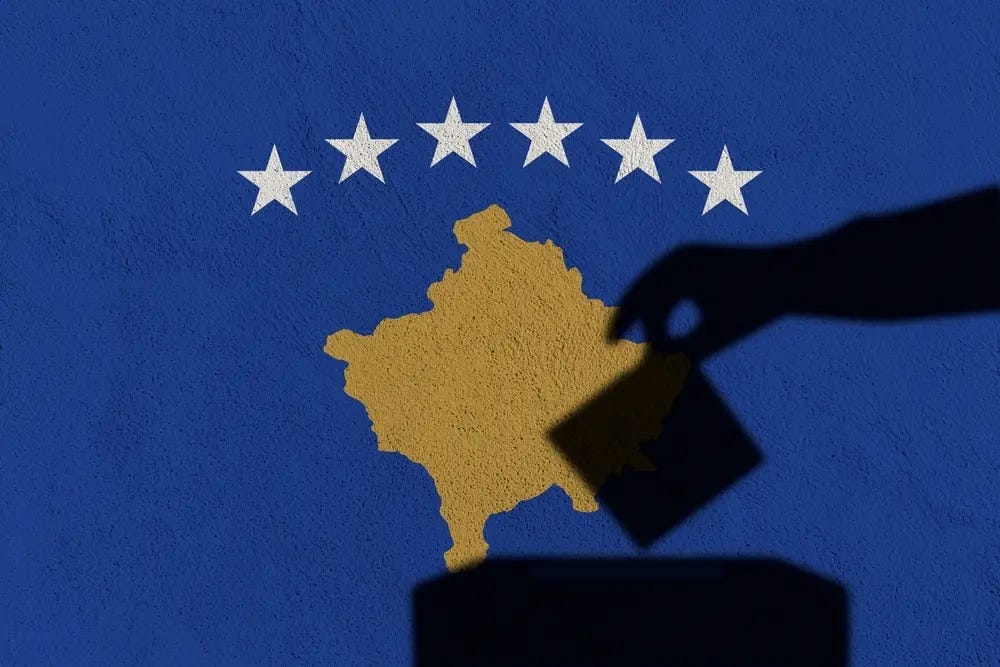
Kosovo’s third election in eighteen months illustrates this. On June 7, 2026, Kosovo held its third parliamentary snap election, in which Prime Minister Albin Kurti’s Vetëvendosje party won 43% of the vote, while the opposition Democratic Party of Kosovo (PDK) and Democratic League of Kosovo (LDK) secured 21% and 17%, respectively.
The vote followed the main parties’ failure to elect a new president within the required timeframe after the December 2025 elections. Although after the June 7 elections, Vetëvendosje is on course to secure 53 seats, this falls short of the 61 needed to form a government. To govern, Kurti must build a coalition with either LDK or PDK — both of which have shown reluctance to join him — or secure support from minority community MPs, an outcome which is not guaranteed this time. Turnout fell to just 37%, and Kosovo finds itself back where it stood after the February 2025 election.
This institutional paralysis is primarily caused by a constitutional mechanism. According to Articles 85 and 86 of the Constitution of Kosovo, after the elections are concluded, a two-thirds majority of all 120 deputies of the parliament in the first two rounds and a simple majority in the third round are required for the election of the new President. Failure to elect a president in any of the three rounds results in automatic dissolution of the Assembly and snap elections afterwards. This mechanism was designed to produce consensus. However, in a fragmented political system where no party brings about a supermajority, such a mechanism becomes a cause of continuous elections.
This institutional paralysis has critical implications for the country, particularly its economy. With a GDP per capita of $20,400, Kosovo was the second-poorest country in Europe as of 2025. Prolonged political crisis has compounded these economic pressures, with Kosovo’s economy already strained by the global energy crisis and rising fuel prices. The same institutional vacuum has also delayed crucial European financing and other international funds. The impasse has delayed Kosovo’s accession to the European Union as Marta Kos, the European Commissioner for Enlargement, commented that there needs to be a stable government capable of serving as a reliable partner for cooperation with the European Union. European Council President Costa has also urged Kosovo to end the impasse. Kosovo’s accession to NATO has also been stalled as US Secretary of State Marco Rubio said that the matter is not a priority for NATO members. Washington’s hesitancy reflects in part its reservations about Kurti and its preference to deal with a stable government led by a duly elected president. According to Al Jazeera, the voters are also frustrated as Gezim Selimi told the AFP news agency that, “I expect parties to finally come to their senses and work for Kosovo.”
Kosovo’s deadlock is not unique. Greece’s constitution employs a similar mechanism requiring a two-thirds parliamentary majority to elect a president, with failure ultimately permitting dissolution. Despite this design intended to ensure consensus, Greece held three elections between June 1989 and April 1990, driven by repeated government formation failures in a fragmented parliament. Ultimately, both cases demonstrate that mechanisms intended to compel consensus can result in successive legislative dissolutions in a politically fragmented state.