

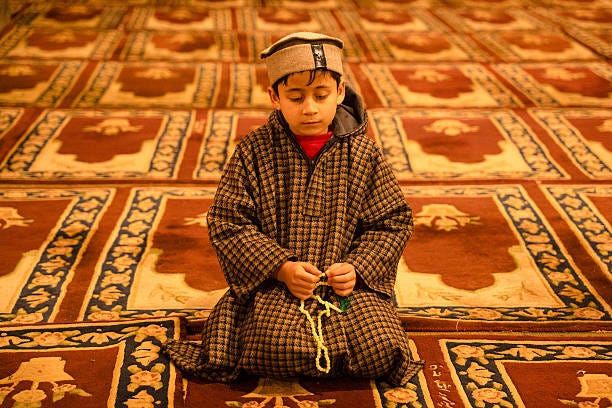
The Faith We Are Given
For many, Islam begins not as a decision but as an environment. It is the sound of the adhan before one understands its meaning, the habit of fasting before one reflects on its purpose, the quiet expectation of prayer before one feels its depth. This is inherited Islam. It is received through family, culture, and community, often wrapped in warmth and belonging.
There is something undeniably powerful about this inheritance. It gives identity early, anchors a person in a tradition, and offers a moral language before one even begins to question it. A child does not choose their first understanding of faith, they absorb it. They learn what it means to be Muslim through observation long before reflection enters the picture.
Yet inheritance, by its nature, does not require understanding. It can exist comfortably without questioning. One may know how to perform the rituals of Islam while remaining distant from their meaning. Prayer becomes movement, fasting becomes routine, and belief becomes assumption. The form is present, but the depth is still waiting to be discovered.
The Moment of Questioning
At some point, often quietly, a shift begins. It may come through exposure to different ideas, through personal hardship, or simply through growing awareness. A person starts to ask why. Why do I believe what I believe? Why does this practice matter? Why does Islam ask what it asks?
This moment is sometimes uncomfortable. Questioning inherited faith can feel like stepping outside something familiar and safe. But it is also necessary. Without it, faith risks remaining shallow, vulnerable to doubt because it has never been examined.
Many young Muslims today experience this transition in subtle ways. A university student might encounter philosophies that challenge religious assumptions. A working professional might struggle to reconcile ethical dilemmas with what they were taught growing up. A person scrolling through social media might come across conflicting interpretations of Islam and feel unsure which one reflects the truth.
These moments are not signs of losing faith. They are often the beginning of choosing it.
Choosing Islam with Intention
Chosen Islam is not separate from inherited Islam, it is what grows out of it when reflection takes place. It is the moment when a person no longer practices simply because they were raised that way, but because they have come to believe in it.
This shift transforms everything. Prayer is no longer an obligation to complete but a space to return to. Fasting is no longer just hunger and restraint but a discipline that shapes the self. The Quran is no longer a text recited for reward alone but a message engaged with for guidance.
One of the most striking contemporary examples can be seen in converts to Islam. Many come to the faith after long periods of searching. They read, question, compare, and reflect before making a decision. When they accept Islam, it carries a clarity that comes from choice. They often describe a sense of certainty not because they inherited it, but because they arrived at it.
What is interesting is that many born Muslims who later reconnect with their faith describe a similar experience. They speak of rediscovering Islam as if encountering it for the first time. In reality, they are moving from inheritance to intention.
Separating Culture from Faith
A major part of this journey involves learning to distinguish between Islam and the cultural practices often attached to it. In many societies, the two are deeply intertwined. Traditions passed down through generations are sometimes treated as religious obligations, even when they are not.
This can create confusion, especially for those trying to understand Islam on its own terms. A person may feel restricted not by the faith itself, but by interpretations shaped by culture. When they begin to question these practices, it can feel like rebellion, when in fact it is a form of clarification.
Scholars have long emphasized the importance of this distinction. Ibn Taymiyyah wrote that faith must be grounded in knowledge and conviction, not blind imitation. This idea remains deeply relevant. A faith that is merely copied can feel heavy or inconsistent. A faith that is understood becomes coherent and meaningful.
Faith That Endures
The difference between inherited and chosen Islam becomes most visible in moments of difficulty. When life becomes uncertain, a borrowed faith can feel distant. It may not provide the answers or the stability one needs because it was never fully internalized.
Chosen Islam, however, tends to endure. A person who understands why they believe is more likely to turn toward faith in hardship rather than away from it. Their belief is not dependent on ease or environment. It is rooted in something deeper.
This does not mean that chosen faith is free from doubt. It means that doubt becomes part of the journey rather than a threat to it. Questions are engaged with, not avoided. Struggles are processed, not ignored.
From Identity to Conviction
Inherited Islam gives a person a place within a tradition. Chosen Islam gives them a relationship with it. One provides identity, the other provides conviction.
The goal is not to discard what was inherited. It is to grow beyond its surface. The rituals, the teachings, the practices all remain, but they are no longer carried passively. They are understood, reflected upon, and lived with intention.
In the end, faith is not only about where one begins. It is about whether one chooses to continue with awareness. Islam, when truly lived, is not simply something a person is born into. It is something they come to know, to understand, and ultimately to choose.