

1. Introduction
At first glance, education appears to be one of the least controversial elements of humanitarian aid. There is extensive international recognition that children displaced by war and persecution should have access to education, stability, and hope for the future. Yet the experience of the Rohingya refugees in Bangladesh demonstrates that education has never been only a humanitarian service. The curriculum, language of instruction, certification, and religious education have become highly politicized issues, reflecting larger struggles about sovereignty, citizenship, identity, and the destiny of one of the world’s largest stateless populations (Dryden-Peterson, 2016; Islam & Mia, 2024).
Systematic discrimination for decades in Myanmar culminated in a military crackdown in August 2017, which forced over one million Rohingya to flee to Bangladesh, where most remain in camps in Cox’s Bazar in extended uncertainty (UNHCR, 2025b). Bangladesh has shown remarkable humanitarian generosity, but what started out as an emergency response has turned into a long-term governance challenge. Education has become one of its most contested dimensions because it raises questions that extend beyond classrooms. Should refugee children follow Bangladeshi or Myanmar curricula? Should their education lead to recognized qualifications? How can humanitarian agencies respect the host state’s insistence that displacement be temporary, while upholding the universal right to education?
These questions reveal that humanitarian schooling is more than a mechanism for delivering educational services. It is a political arena where governments, humanitarian organisations, donors, and refugee communities negotiate competing visions of protection, authority, and belonging. In this essay, “humanitarian schooling” refers to refugee education delivered through humanitarian institutions outside the host state’s formal education system and continuously shaped by negotiation between humanitarian principles and sovereign political authority. This essay argues that humanitarian schooling in Bangladesh should be understood as a form of humanitarian governance through which refugee populations are simultaneously protected and regulated (Barnett & Weiss, 2008). Based on the scholarship of Dryden-Peterson (2016) on refugee education and Agamben’s (1998) concept of the state of exception, it demonstrates how the Rohingya experience exemplifies the ongoing contestation between the universal right to education and the sovereign right of states to determine the conditions under which displaced populations are able to learn, belong, and envision their futures.
These questions imply that humanitarian schooling is more than a mechanism of providing educational services. It is a political arena where governments, humanitarian organizations, donors, and refugee communities negotiate competing visions of protection, authority, and belonging. This essay argues that humanitarian schooling in Bangladesh should be understood as a form of humanitarian governance through which refugee populations are simultaneously protected and regulated (Barnett & Weiss, 2008). It is a political domain where governments, humanitarian organizations, donors and refugee communities negotiate competing visions of protection, authority and belonging. This study argues that humanitarian schooling in Bangladesh should be understood as a form of humanitarian governance that simultaneously protects and regulates refugee populations (Barnett & Weiss, 2008).
2. The Rohingya Crisis and the Right to Education
Education is an integral and defining feature of every refugee crisis. It not only provides knowledge and stability, but also shapes identity, belonging, and the future. The Rohingya experience demonstrates how these humanitarian and political issues become indistinguishable in situations of protracted displacement.
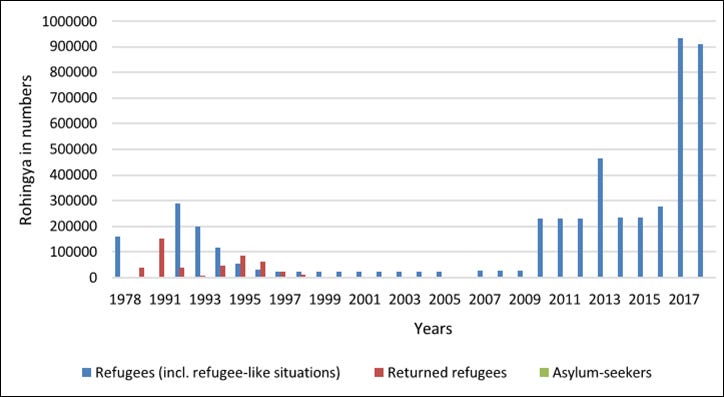
The contemporary Rohingya crisis is rooted in decades of systematic exclusion and statelessness. The 1982 Citizenship Law effectively nullified the Rohingya’s citizenship status and the military crackdown of August 2017 forced more than 740,000 people to flee to Bangladesh. The Rohingya population, along with earlier arrivals, now exceeds one million, making Cox’s Bazar the world’s largest refugee settlement (Kipgen, 2013; UNHCR, 2025b). What began as an emergency humanitarian response has now turned into a prolonged displacement crisis, with no immediate durable solution in sight (Islam et al., 2026).
Figure 1: Rohingya refugee flows in Bangladesh
Source: Hossain, 2023.
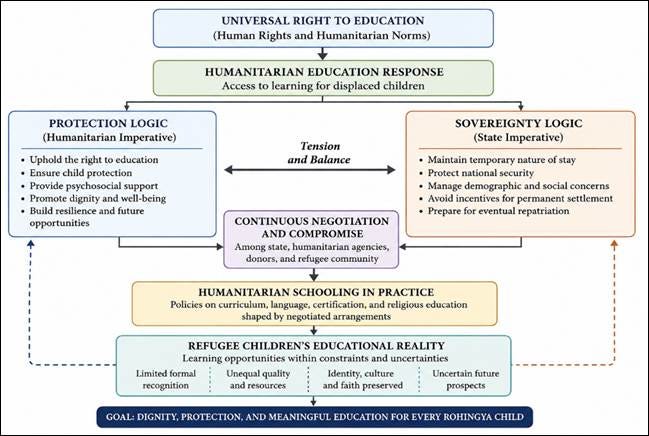
As displacement has become prolonged, education has become one of the most contentious dimensions of refugee protection. Education is a universal right regardless of nationality or legal status as recognized in the Universal Declaration of Human Rights, the Convention on the Rights of the Child and Sustainable Development Goal 4 (United Nations, 1948, 1989, 2015). Refugee education is therefore, in principle, a matter of rights rather than charity. In practice, however, the implementation is determined by the political priorities of host states (Dryden-Peterson, 2016). Although Bangladesh is home to more than a million Rohingya, but is not a signatory to the 1951 Refugee Convention, and officially refers to them not as refugees but as Forcibly Displaced Myanmar Nationals (Islam & Mia, 2024). This terminology reflects the state’s commitment to keeping displacement temporary and avoiding policies that might promote permanent settlement. Thus, decisions concerning curriculum, certification and access to formal education have become closely linked to broader concerns about sovereignty, national security and future repatriation (Shohel, 2020).
The Rohingya case, thus, reveals a core paradox of refugee governance. While education is a universal human right in international norms, the reality of education provision is still constantly negotiated within the limits of state sovereignty. This tension is key to understanding how humanitarian schooling in Bangladesh has become a politically negotiated space rather than simply an educational system (Dryden-Peterson, 2016).
3. Humanitarian Schooling in Bangladesh
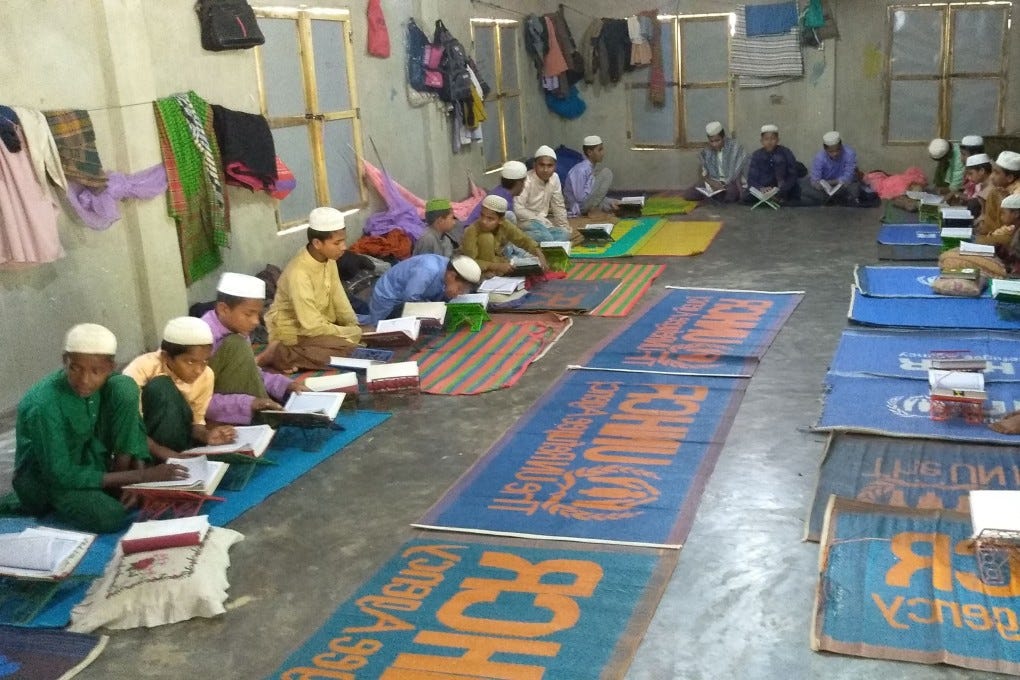
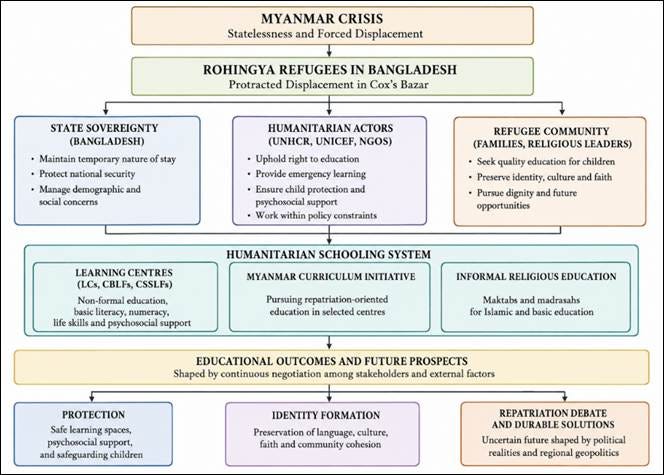
Since the mass displacement of Rohingya in 2017, Bangladesh has embraced a model of refugee education that reflects a careful balance between humanitarian responsibility and political restraint. Instead of integrating Rohingya children into the national education system, the government has permitted education mainly through humanitarian learning centres run by international and non-governmental organizations. The arrangement has augmented access to education and further solidified the state’s broader objective of securing the temporary nature of refugee protection (Islam & Mia, 2024). Thus, humanitarian schooling has become a parallel system of education that is designed not only to educate refugee children but also to govern prolonged displacement.
Figure 2: Humanitarian Schooling as a Politically Negotiated System
Source: Adapted by the author based on Islam and Mia (2024); Dryden-Peterson (2016); UNICEF (2022); and UNHCR (2025a).
Education in the camps is facilitated through a broad humanitarian partnership led by UNICEF, UNHCR, IOM and their implementing partners. There are now thousands of learning centres providing literacy, numeracy, life skills and psychosocial support, greatly enhancing education access compared to the immediate post-2017 influx (ISCG, 2019; UNICEF, 2022). But these institutions are largely informal. Most students do not obtain nationally or internationally recognized qualifications, and scopes for progression to secondary or higher education remain extremely limited (Hossain, 2023).
This distinction between humanitarian learning and formal education is politically important. The question has never been whether Rohingya children should be educated, but rather what kind of education is compatible with Bangladesh’s refugee policy. For years, the Learning Competency Framework and Approach (LCFA) was followed by children which was designed as an emergency curriculum in humanitarian contexts. Concern that a prolonged dependence on emergency education could lead to a “lost generation” without recognized qualifications led the Government of Bangladesh to approve the phased introduction of the Myanmar national curriculum in selected learning centres from 2021, supported by UNICEF and other humanitarian partners (UNICEF, 2022). This policy represented a political compromise: to improve educational continuity while strengthening the expectation that the Rohingya would eventually return to Myanmar, rather than integrate into the national education system of Bangladesh.
Despite this policy shift, application has been constrained due to the shortages of qualified teachers, inadequate learning materials, language barriers, overcrowded classrooms and ongoing uncertainty about the future of Myanmar (Shohel, 2020). At the same time, learning centres offer far more than academic instruction including psychosocial support, protection from child labour and early marriage, and opportunities to rebuild social relationships after displacement (Dryden-Peterson, 2016). Humanitarian schooling is thus simultaneously a means of education, protection and community support (Islam & Mia 2024).
This duality lies at the core of the Rohingya education system. Humanitarian schooling has kept hundreds of thousands of children out of educational exclusion, but its architecture also reproduces the political boundaries of refugee governance. It offers access to education but also limits long term integration, and exemplifies how humanitarian protection and state sovereignty are always being negotiated within the classroom itself.
4. Education as a Political Arena
Humanitarian schooling is not all about delivering education only; it is also a mechanism of negotiation among competing political interests. Educational decisions about curriculum, language of instruction, certification, and access to formal schooling in the Rohingya camps are inherently intertwined with larger political questions of authority, citizenship, identity, and the future of one of the world’s largest displaced populations (Islam & Mia, 2024). Hence, education has become a political space where the priorities of a state, humanitarian organizations, international donors and refugee communities converge.
Figure 3: Education Between Protection and Sovereignty
Source: Adapted by the author from Barnett and Weiss (2008); Agamben (1998); Dryden-Peterson (2016); Shohel (2020); Islam & Mia (2024); UNICEF (2022).
For the Government of Bangladesh, education cannot be detached from the wider politics of displacement. The state has consistently emphasized the temporary character of the Rohingya presence, while also providing humanitarian protection. This goal is reflected in its naming the Rohingya Forcibly Displaced Myanmar Nationals, instead of refugees, and in its policies focused on tightly controlled humanitarian learning centres instead of accredited formal education (Shohel, 2020; Islam & Mia, 2024). Accordingly, the curriculum, certification and institutional expansion are carefully managed to avoid the possibilities of permanent integration. In many ways, the Rohingya camps illustrate what Agamben (1998) describes as a state of exception, where displaced people are subject to state authority without enjoying the full rights of citizenship.
Education is viewed by the humanitarian organisations from a different perspective. For agencies such as UNICEF and UNHCR, education is a universal human right and a critical part of child protection and long-term resilience (Dryden-Peterson, 2016; UNICEF, 2022). But these organisations operate within the political boundaries of the host state. The core of humanitarian governance is inherently political, as humanitarian actors always negotiate between universal principles and state sovereignty (Barnett & Weiss, 2008). The Rohingya response exemplifies this dilemma: humanitarian agencies seek broader access to education, but only within the framework determined by broader refugee policy of Bangladesh.
International donors add another layer of complexity. Its fragility has been brought out by donor priorities, while their funding has made it possible to extend humanitarian education. Human Rights Watch (2025) reports that recent funding cuts have derailed learning programs, halted recruitment of teachers, and jeopardized education for hundreds of thousands of Rohingya children. Simultaneously, Rohingya families have pursued their own educational aspirations through formal credentials, cultural identity preservation, and community-based initiatives. Their priorities do not always align with those of governments or humanitarian agencies. The refugee education space is not only shaped by institutions but also by the agency of displaced communities.
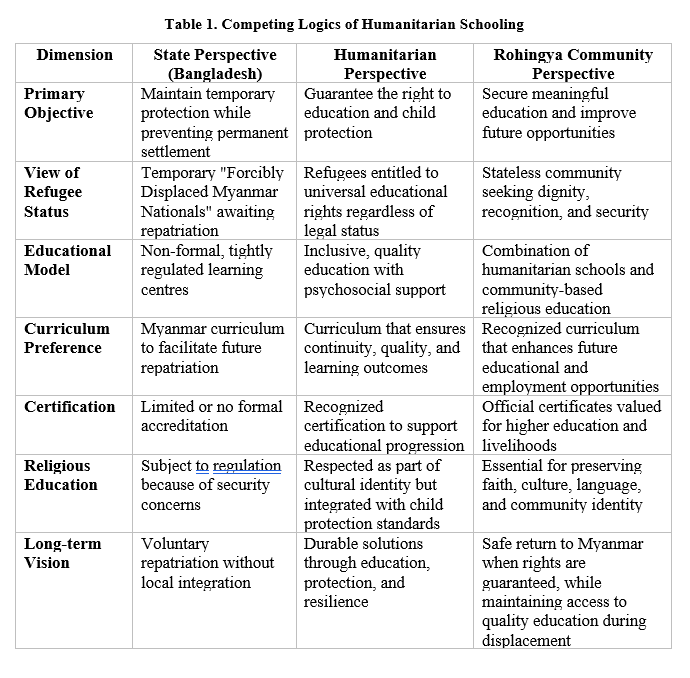
Source: Adapted by the author from Dryden-Peterson (2016); Shohel (2020); Islam & Mia (2024); UNICEF (2022); UNHCR (2025a).
Thus, the politics of refugee education extends far beyond the classroom. Humanitarian schooling has developed into a governance mechanism through which state sovereignty, humanitarian responsibility, donor priorities, and refugee aspirations are continuously negotiated. The Rohingya case demonstrates that education is neither politically neutral nor purely humanitarian; it is one of the central sites in which the future of displaced populations is imagined, managed and contested.
5. Religious Education, Identity, and Community Agency
Humanitarian learning centres are not the only educational institutions within the Rohingya camps. Alongside them, many families continue to rely on community-based maktabs and madrasahs. Their importance reflects more than religious preference. According to Islam and Mia (2024) these have emerged as community responses to prolonged displacement, limited access to recognized formal education, and enduring uncertainty about the future.
For a stateless community whose identity has long been denied, religious education serves multifarious purposes. Besides teaching Qur’anic studies, Islamic ethics, Arabic, and basic literacy, these institutions help to preserve cultural memory, strengthen communal solidarity, and provide children with continuity amid displacement (Parnini, 2013). They also provide psychosocial support through re-establishing routine and reinforcing social cohesion after conflict and forced migration (Hyunjung & Hoque, 2024). Hence, community-based religious education complements humanitarian schooling and meets needs beyond academic instruction.
At the same time, the growth of informal religious education has created concerns among government officials and humanitarian organizations. Karim (2023) notes that many madrasahs operate outside of formal regulatory frameworks, raising concerns about curriculum quality, teacher training, institutional oversight and child protection. Furthermore, Bangladesh authorities have expressed their security concerns about the unregulated educational spaces in the camps (Hossain, 2023). There is little empirical evidence of widespread radicalization, but these concerns have had a major impact on state policy towards community-led education.
However, seeing religious education through a security lens alone ignores the agency of the Rohingya community. Refugees are not just passive recipients of humanitarian assistance, but active participants in shaping the education of their children. Community-led religious schools are attempts to keep identity alive and fill the voids left by the formal humanitarian system (Islam & Mia, 2024). Therefore, a more balanced approach is one of proper regulation and positive engagement. Sustainable refugee education relies not only on humanitarian organizations and governments but also on active involvement of refugee communities themselves.
6. From Emergency Response to Long-Term Challenge
Recent developments have exposed the growing fragility of humanitarian schooling for the Rohingya. While earlier debates centred on curriculum and educational access, the most pressing challenge today is the sustainability of the system itself. Decreasing international financial support has revealed the vulnerability of an education model that heavily relies on humanitarian assistance, rather than on long-term institutional arrangements.
In June 2025, UNICEF reported that several education programs had been suspended or scaled back due to funding shortfalls, including the termination of contracts for more than a thousand education workers in the Rohingya camps (UNICEF, 2025). These cuts have endangered the learning opportunities of thousands of children and increased the chances of long-term educational loss. The funding crisis has also refocused attention on community-run schools, many of which continue to provide educational endurance to refugee children without formal recognition (Human Rights Watch, 2025).
These difficulties are compounded by the ongoing instability in Myanmar. The renewed fighting in Rakhine State and the lack of conditions for safe and voluntary repatriation make it increasingly clear that the displacement is unlikely to end soon (Reuters, 2026; UNHCR, 2025b). Education can therefore no longer be viewed as a short-term humanitarian response. It has become a long-term political and development challenge, which requires sustained international support, increased cooperation with refugee communities, and policies that reconcile Bangladesh’s legitimate sovereignty concerns with the universal right to education.
7. Conclusion
The Rohingya experience illustrates that refugee education is never simply about access to classrooms. In situations of prolonged displacement, education becomes intensely intertwined with issues of sovereignty, citizenship, identity and political belonging. Humanitarian schooling in Bangladesh demonstrates that educational policy is shaped not only by humanitarian commitments but also by negotiations among governments, international organisations, donors, and refugee communities.
Bangladesh has sought to strike a balance between its humanitarian obligations and legitimate concerns over sovereignty and the temporary nature of refugee protection. Meanwhile, humanitarian agencies have tried to defend education as a universal right. At the same time, Rohingya families have developed their own educational strategies to m preserve their identity and expand opportunities for the future. This generates a system that simultaneously protects and regulates refugee populations, reflecting the complexities of humanitarian governance.
The Rohingya experience is not an isolated example, but a case study of a wider global dilemma. As displacement is protracted, refugee education is shifting from an emergency response to a long-term question of governance, rights and political responsibility. It requires sustained political commitment, predictable international assistance, and greater acknowledgement of refugee communities as active partners in shaping education policy. Finally, the future of humanitarian schooling will depend not only on resources, but also on whether governments and the international community treat education as a foundation for dignity, resilience, and sustainable solutions, rather than simply as a mechanism for managing displacement.
About the Author:
Dr. Md. Thowhidul Islam
Professor of Islamic History & Culture
Center for General Education
International Islamic University Chittagong
Bangladesh-4318. Cell: +88-01817078263
E-mail: tauhidcox@gmail.com; tauhidcox@iiuc.ac.bd.
Scopus ID: 57208297573 I ORCID ID: 0000-0002-2407-8422
Web of Science Researcher ID: ACL-8228-2022
References
Agamben, G. (1998). Homo sacer: Sovereign power and bare life (D. Heller-Roazen, Trans.). Stanford University Press.
Barnett, M., & Weiss, T. G. (Eds.). (2008). Humanitarianism in question: Politics, power, ethics. Cornell University Press.
Dryden-Peterson, S. (2016). Refugee Education: The Crossroads of Globalization. Educational Researcher, 45(9), 473-482. https://doi.org/10.3102/0013189X16683398
Hossain, A. A. N. M. Z. (2023). Educational crisis of Rohingya refugee children in Bangladesh: Access, obstacles, and prospects to formal and non‑formal education. Heliyon, 9(7), Article e18346. https://doi.org/10.1016/j.heliyon.2023.e18346
Human Rights Watch. (2025, June 25). Bangladesh: Foreign aid cuts affect Rohingya children’s education. https://www.hrw.org/news/2025/06/25/bangladesh-foreign-aid-cuts-affect-rohingya-childrens-education
Hyunjung, L. & Hoque, M. M. (2024). Rohingya Refugee Education in Malaysia: An Analysis of Current Standards and Challenges. Asian Journal of Education and Social Studies, 50(7), 416–437. https://doi.org/10.9734/ajess/2024/v50i71474
Inter Sector Coordination Group (ISCG). (2019). Cox’s Bazar education sector dashboard. https://reliefweb.int/report/bangladesh/education-sector-dashboard-coxs-bazar-bangladesh-7-october-2019
Islam, A. K. M. I., Islam, M. T., Shamsuzzoha, A. T. M., & Amin, M. N. (2026). After humanitarianism: A comparative study of the Muslim world’s Rohingya policy. Journal of Muslim Philanthropy & Civil Society, 10(1), 3-25. https://scholarworks.iu.edu/iupjournals/index.php/muslimphilanthropy/article/view/6434
Islam, M. S., & Mia, M. E. (2024). Navigating Legal and Humanitarian Challenges Regarding the Rohingya Refugee Crisis in Bangladesh. International Journal of Social Inquiry, 17(3), 467-491. https://doi.org/10.37093/ijsi.1487343
Karim, M. U. H. F. (2023). Refugee education in Bangladesh: A nation‑state paradox. Journal of Population and Social Studies, 31, 762–782. https://doi.org/10.25133/JPSSv312023.042
Kipgen, N. (2013). Conflict in Rakhine State in Myanmar: Rohingya Muslims’ Conundrum. Journal of Muslim Minority Affairs, 33(2), 298–310. https://doi.org/10.1080/13602004.2013.810117
Parnini, S. N. (2013). The crisis of the Rohingya as a Muslim minority in Myanmar and bilateral relations with Bangladesh. Journal of Muslim Minority Affairs, 33(2), 281–297. https://doi.org/10.1080/13602004.2013.826453
Prodip, M. A. H. (2023). Education for what? The politics of education for Rohingya refugees in Bangladesh. Politics & Policy, 51(6), 1028–1045. https://doi.org/10.1111/polp.12541
Reuters. (2026, June 2). UN warns funding cuts could worsen Rohingya crisis in Bangladesh. https://www.reuters.com/world/asia-pacific/un-warns-funding-cuts-could-worsen-rohingya-crisis-bangladesh-2026-06-02/
Sejan, S. S., & Farque, M. O. (2026). Rohingyas as “FDMNs” in Bangladesh: Implications for their right to education. Opinio Juris. https://opiniojuris.org/2026/05/05/rohingyas-as-fdmns-in-bangladesh-implications-for-their-right-to-education/
Shohel, M. M. C. (2020). Education in emergencies: challenges of providing education for Rohingya children living in refugee camps in Bangladesh. Education Inquiry, 13(1), 104–126. https://doi.org/10.1080/20004508.2020.1823121
UNICEF. (2022, May 1). Education milestone for Rohingya refugee children as Myanmar curriculum pilot reaches first 10,000 children. UNICEF Bangladesh. https://www.unicef.org/bangladesh/en/press-releases/unicef-education-milestone-rohingya-refugee-children-myanmar-curriculum-pilot UNICEF
UNICEF. (2025, June 3). UNICEF statement on education program funding challenges for Rohingya refugee children. https://www.unicef.org/bangladesh/en/press-releases/unicef-statement-education-program-funding-challenges-rohingya-refugee-children
United Nations High Commissioner for Refugees. (2025). Education: Build better futures. https://www.unhcr.org/what-we-do/build-better-futures/education
United Nations High Commissioner for Refugees. (2025). Rohingya emergency. https://www.unhcr.org/rohingya-emergency.html
United Nations. (1948). Universal Declaration of Human Rights. https://www.un.org/en/about-us/universal-declaration-of-human-rights
United Nations. (1989). Convention on the Rights of the Child. https://www.ohchr.org/en/instruments-mechanisms/instruments/convention-rights-child
United Nations. (2015). Transforming our world: The 2030 Agenda for Sustainable Development. https://sdgs.un.org/2030agenda
United Nations. (2016). Global education monitoring report 2016: Education for people and planet: Creating sustainable futures for all. UNESCO. https://www.unesco.org/gem-report/en/publication/education-people-planet-creating-sustainable-futures-all