

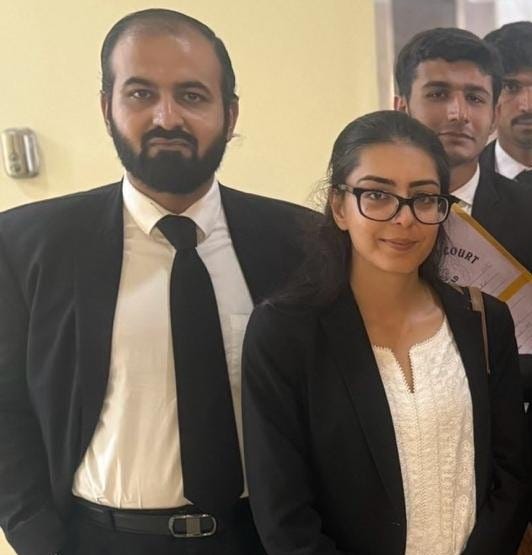
On June 13, 2026, human rights lawyers Imaan Mazari and Hadi Ali Chattha were awarded the Ludovic Trarieux Prize, the world’s oldest and most prestigious human rights prize for lawyers, while imprisoned in Pakistan. The prize recognised their work defending victims of forced disappearances, blasphemy charges, and sexual violence. The social media posts that led to their conviction addressed the enforced disappearances that have long defined their legal work. The sentences were imposed under Sections 9 (glorification of an offence), 10 (cyberterrorism), and 26-A (false and fake information) of Pakistan’s Prevention of Electronic Crimes Act (PECA) 2016: a law whose vague language allows the same act to be read as a lawful expression or serious crime, depending only on who is interpreting it.
On 23 January 2026, Imaan and Hadi were arrested by Islamabad police while travelling in the Islamabad High Court Bar Association’s (IHCBA) vehicle to a hearing in the District Sessions Court for the controversial “tweets case.” They were arrested without an FIR or arrest warrant, violating a prior IHC bail protection order issued two days earlier. Immediately after their arrest, backdated FIRs were revived, including a July 2025 terrorism charge. On January 24, the day of sentencing, Mazari and Chattha appeared via video link from Adiala Jail before Judge Muhammad Afzal Majoka. According to a report by the International Commission of Jurists, the hearing lasted less than a minute before the couple, alleging mistreatment and denial of food and water in custody, boycotted the proceedings.
That conviction rested on PECA’s own statutory language, which is itself not precisely defined. Section 9 defines “glorification” as “depiction of any form of praise or celebration in a desirable manner”. Cyberterrorism under Section 10 requires only intent to “create a sense of fear, panic or insecurity... in society,” a threshold any pointed criticism of state institutions could meet. Under this framework, the couple were sentenced to five years under Section 9, ten years under Section 10, and two years under Section 26-A, each with separate fines; running concurrently, their effective term is ten years.
The same proceeding that produced this sentence was itself marked by procedural breaches. A transfer application remained pending before the Islamabad High Court when the Sessions Court proceeded to sentencing. The couple were also denied the opportunity to complete cross-examination of prosecution witnesses. The process was condemned by the UN Special Rapporteurs, the Human Rights Commission of Pakistan, Amnesty International, and three bar associations: the Islamabad High Court Bar Association (IHCBA), Sindh High Court Bar Association, and Islamabad Bar Council.
This was not Mazari’s first encounter with Pakistan’s legal system. According to a joint statement by five UN Special Rapporteurs, Mazari and Chattha have faced ten criminal complaints since 2022, none of which had previously resulted in a conviction. The experts described this as ‘an arbitrary use of the legal system as an instrument of harassment and intimidation’ aimed at punishing the couple for their human rights advocacy.
Taken together, these proceedings sit at the centre of a broader tension between Pakistan’s domestic laws and international standards on free expression making it a tension reflected in the condemnations of the UN Special Rapporteurs, Amnesty International, the Human Rights Commission of Pakistan, and Pakistan’s own bar associations.
When the same work that earns international recognition is treated as a crime at home, the gap raises a question that outlasts this single case: which standard reflects the practice of law, and which reflects its punishment?