
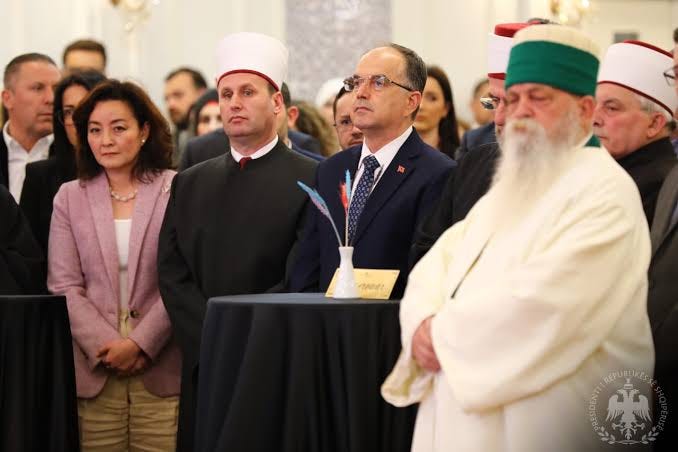
Viewed from a contemporary perspective, Albania is a society in which the two major Abrahamic traditions, Christianity and Islam, coexist through their respective communities. Within Christianity, Catholic, Orthodox, and Evangelical communities are present, while the Islamic tradition is represented mainly by Sunni and Bektashi Muslims.
Albania’s religious landscape is even more diverse. The country includes mixed families in which different religious affiliations coexist. Albania is a secular state, and its Constitution recognises no official religion, while guaranteeing the freedom and equality of religious communities.
This is particularly significant in a country where, in 1967, the communist regime officially banned religion, closed religious institutions, and excluded faith from public life. After the fall of communism, the restoration of religious freedom meant more than the reopening of mosques and churches; it represented the recovery of a fundamental right and the reconstruction of the country’s spiritual and social memory.
The revival of religious life in the early 1990s was not accompanied by interfaith confrontation. On the contrary, coexistence returned with remarkable naturalness, showing that the foundations of harmony had survived even after decades of imposed atheism.
The Personal Roots of a Commitment to Dialogue
For me, an interest in interfaith dialogue has never been only an academic choice. It is connected to my birthplace, my education, and my family heritage.
I was born in Shkodra, a city historically known for interfaith coexistence, where mosques, churches, traditions, and families of different religious affiliations have formed a natural part of the same social reality. In such an environment, the other was not necessarily perceived as a stranger, but as a neighbour, friend, fellow citizen, and part of the same shared history.
The legacy of my grandparents and great-grandparents has also had a special influence on me, particularly the figure of Hadji Ibrahim Kaduku. He served as a mufti, director of a madrasa, vice-president of the Albanian Muslim Community, and teacher in madrasas and schools in Istanbul and Edirne in Türkiye, before continuing his educational and religious work in Shkodra and Kavaja.
This heritage helped me understand religious knowledge not as an instrument of isolation, but as a public responsibility. A scholar or religious leader should not only preserve and transmit his own tradition; he should also build bridges, educate future generations, and contribute to peace, justice, and social understanding.
After completing my Bachelor’s degree in Sociology at Istanbul University, I deepened this interest through my Master’s studies and later my doctorate at the University of Tirana. Interfaith dialogue became the field in which personal experience, sociological formation, and academic research came together.
In my studies, I have tried to approach dialogue not only as a theological issue, but also as a social process shaped by history, culture, education, institutions, and collective memory.
As I have argued in my monograph on the history of interfaith dialogue, dialogue is not only desirable but necessary. Its central purpose is to create continuous communication between people, cultures, and traditions without erasing the differences among them.
The Beginnings of Academic Interfaith Cooperation
Academic interfaith cooperation in Albania began in the early 2000s through the initiatives of the Prizmi Institute for Dialogue. Through this institute, reciprocal visits and meetings began with the Catholic Institute of Philosophy and Theology at the Interdiocesan Seminary in Shkodra, and with the Orthodox Theological Academy in Shën Vlash, Durrës.
These contacts did not remain at the level of institutional greetings. They created concrete opportunities for students, lecturers, and theological institutions to become acquainted with one another.
I was subsequently able to deliver several lectures on interfaith dialogue in Islam and on the history of religious coexistence in Albania. Following the establishment of the Department of Islamic Sciences at Bedër University College in 2011, Catholic and Orthodox lecturers were also invited to present their traditions to students of Islamic Studies.
One of the greatest obstacles to dialogue is that people often learn about another religion through indirect sources, stereotypes, or polemical interpretations. When a Muslim learns about Christianity from a Christian theologian and a Christian learns about Islam from a Muslim scholar, a more honest standard of knowledge is created.
This method does not eliminate differences. It makes them more understandable and frees them from prejudice.
These early meetings generated trust between institutions and created personal relationships among lecturers and leaders. Without this capital of trust, long-term cooperation would have been far more difficult.
From Reciprocal Visits to an Academic Tradition
One of the first documented activities in this journey was the Seminar on Interfaith Dialogue held on 13 April 2014 at the Catholic Theological Institute.
On 8 September 2015, the conference “Peace Is Always Possible – Albania as a Model of Interfaith Coexistence” placed the Albanian experience within a broader discussion of peace and relations among faiths.
On 2 December 2015, the First Interfaith Symposium, “Freedom of Religion and Interfaith Dialogue in Albania,” was organized at Bedër University College. Held on the twenty-fifth anniversary of the restoration of religious freedom after communism, it connected the memory of religious persecution with the responsibility to protect freedom of conscience in a democratic society.
This symposium was not the absolute beginning of cooperation. It was the institutionalisation of a process that had begun years earlier.
On 14 January 2016, the panel “Open Society, Democracy and Education as Weapons against Extremism” was held, followed on 20 April by another interfaith meeting at Bedër University College.
On 12 May 2016, the 2nd Interfaith Symposium, “Creation and the Human Being as Its Steward,” presented Islamic, Orthodox, and Catholic perspectives on creation and humanity’s moral responsibility towards nature.
Only a few days later, on 24 May 2016, the Catholic Theological Institute hosted the seminar “Interfaith Dialogue from an Islamic Perspective,” continuing the tradition of direct lectures and reciprocal exchanges between institutions.
In 2017, cooperation became further consolidated. The 3rd Interfaith Symposium, “The Family from Christian and Islamic Perspectives,” addressed the family as the foundation of society, the education of children, respect for parents, communication, and mutual responsibility among family members.
The 4th Symposium, “Women in Religious Communities and in Albanian Society Today,” held in Shkodra, brought together voices and perspectives from different traditions on the role of women in religious and social life.
The 5th Symposium, “Divine Love,” took place on 14 December 2017 and continued reflection on spiritual values capable of creating spaces of encounter among traditions.
The 6th Symposium, “The Mystery and Fruits of Prayer,” presented Islamic, Orthodox, and Catholic perspectives on prayer, worship, and the importance of spiritual life.
The 7th Symposium, “Mary/Maryam as a Symbol of Virtue and Devotion,” focused on a figure honoured in both Christianity and Islam, showing how dialogue can develop through shared figures and values without denying theological differences.
The 8th Symposium, “The Challenges of Religion in Globalisation,” introduced a significant innovation: the principal speakers were students from the three theological institutions. This demonstrated that dialogue was being entrusted to younger generations and was no longer solely the responsibility of senior leaders.
The 9th Symposium, “Religious Faiths and Human Fraternity,” examined the need for solidarity in a world marked by polarisation, exclusion, and conflict.
During the pandemic, the 10th Interfaith Symposium, “Religious Faiths and the Challenges of COVID-19,” addressed fear, isolation, suffering, and the pastoral and social role of religious institutions during an extraordinary period.
The 11th Symposium, “The Concept of Peace from a Religious Perspective,” placed peace at the centre of theological and social reflection.
The 12th Symposium, “Hope in Eternal Life and Life in This World,” explored the meaning of hope at a time marked by identity, social, and humanitarian crises. Hope was understood not as passive optimism, but as a source of moral resilience and responsibility towards life.
The 13th Symposium, “The Human Being Acting as God: Bioethical Issues in Modern Society,” extended dialogue to contemporary dilemmas related to science, technology, life, and human dignity.
The 14th and most recent Interfaith and Intertheological Symposium, held in April 2026, “The Role of Christianity and Islam in Addressing Climate Issues,” connected the tradition of academic dialogue with one of the most urgent global challenges: climate change and shared responsibility for creation.
This thematic continuity shows that academic interfaith dialogue did not remain confined to tolerance. It expanded to the family, the role of women, prayer, globalisation, peace, the pandemic, bioethics, and climate.
The opening included a documentary on the history of academic interfaith cooperation. The academic sessions examined environmental responsibility from theological and ethical perspectives, while students from the three theological institutions participated in joint workshops. The event emphasized that this cooperation among theological institutions represents a distinctive Albanian model that should be preserved, documented, and promoted internationally.
The International and Interfaith Conference
An important moment in this cooperation was the international conference “Albania: A Model of Interfaith Coexistence for Europe?”, organised on 3 May 2018 by Bedër University College, the Catholic University “Our Lady of Good Counsel,” University College Logos, and the five religious communities in Albania, with the support of the Austrian Embassy in Tirana.
The conference brought together religious leaders, state representatives, academics, researchers, and theologians from Albania and Europe. At the conclusion of the joint panel, the leaders of the religious communities signed a declaration of commitment to continue and strengthen interfaith dialogue in Albania.
The academic panels examined the history, present reality, and future prospects of Albanian religious coexistence. The conference placed this experience in a broader European context and underlined the need for the Albanian model not to remain merely a national symbol, but to be studied, documented, and further developed through academic cooperation.
The Interreligious Council of Albania
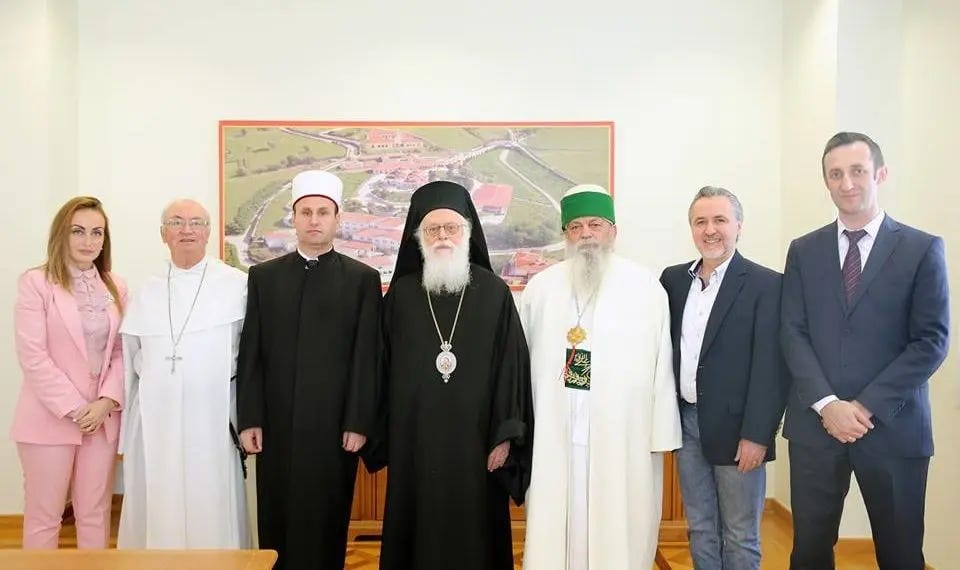
An important institutional expression of this spirit is the Interreligious Council of Albania, founded on 25 October 2007 by the leaders of the four traditional religious communities. In 2018, the Evangelical Brotherhood of Albania was admitted as a full member, becoming the fifth religious community represented in the Council.
The Council’s mission is to promote interfaith dialogue and harmony through joint projects, declarations, and activities. It has also been an important partner in connecting academic institutions with religious communities and in transforming dialogue into concrete action.
The Council has received national and international recognition for its contribution, including the De Mello Human Rights Award in 2018, an award from the Austrian Federal Ministry for European and International Affairs in 2021, and the high state decoration “Honor of the Nation”, awarded in 2021 by the President of the Republic of Albania.
From National to European Cooperation
The Albanian experience of interfaith dialogue has also expanded through Religions for Peace Europe. In January 2024, I was elected President of the European National Interreligious Bodies, and in January 2025, President of Religions for Peace Europe, while continuing to serve as Secretary General of the Interreligious Council of Albania. This role provides an opportunity to share the Albanian model of cooperation among religious communities, universities, and theological institutions within a broader European network committed to dialogue, freedom, and peace.
Erasmus+ and the International Expansion of Cooperation
A new phase of this cooperation developed through the Erasmus+ project “Facing Global Challenges: Environmental and Peace Education in Interreligious Cooperation for Religious Teacher Training.”
The project brought Bedër University College together with KPH Wien/Krems in Austria, the University of Augsburg in Germany, Universitat Internacional de Catalunya in Spain, and the International Islamic University of Malaysia. Its aim was to integrate environmental education, peace education, and interfaith dialogue into the training of religion teachers and into university practice.
In April 2025, Tirana hosted a three-day international academic meeting involving scholars, lecturers, and representatives of religious communities. One of its main activities was the symposium “The Role of Faith Actors in Climate Responsibility and Environmental Protection: The Case of Albania,” organized by the Interreligious Council of Albania, through its Youth and Women’s Departments, in cooperation with Bedër University College.
As part of the meeting, a cypress tree was planted symbolically in the courtyard of the Archdiocese of Tirana as a sign of continuity in dialogue, peace, and responsibility towards creation.
This international cooperation placed the Albanian experience in dialogue with universities and institutions from different religious and cultural settings, showing that the model developed in Albania can contribute to global discussions on education, peace, and sustainability.
From Tolerance to Active Cooperation
The Albanian experience shows that religious freedom is not protected by laws and constitutions alone. It must also be supported by education, institutions, social habits, and responsible leadership.
A society may have good legislation and still suffer from prejudice. Likewise, a strong tradition of coexistence can weaken if it is not transmitted to younger generations.
For this reason, academic dialogue has particular importance. It allows students to learn about other traditions from direct and reliable sources. It also teaches them how to disagree without showing contempt for one another.
The challenge for the future is to move from passive tolerance to active cooperation.
It is not enough to say that Albanians have always lived in harmony. This heritage must be preserved and developed in the context of globalisation, migration, digital communication, political polarisation, and environmental challenges.
Dialogue should involve not only religious leaders, but also students, women, young people, teachers, researchers, and civil society organisations.
It should move beyond relations among religions and include joint action in education, environmental protection, social justice, migrant integration, and the ethical use of technology.
An Albanian Message for a Divided World
The Albanian experience is not perfect and cannot be copied mechanically in every country. Each society has its own history and challenges.
Nevertheless, it offers several principles of universal value: religious identity should not be used as a weapon; freedom must be accompanied by responsibility; dialogue should be cultivated before conflict emerges; and education should serve as one of the principal means of preventing hatred.
The initiative that began in the early 2000s, continued through visits, lectures, and academic exchanges, and later developed through conferences, international projects, and interfaith symposiums, shows that dialogue takes time.
It is built through repeated contact, friendship, institutional trust, and the engagement of younger generations.
Albania’s most distinctive contribution lies precisely in this academic interfaith cooperation: Muslim and Christian institutions that do not limit themselves to symbolic declarations, but create shared spaces for study, reflection, and education.
In this process, dialogue is no longer merely a conversation. It becomes knowledge, education, citizenship, and common action for peace.
Through academic cooperation, this experience is increasingly being shared with partners across Europe, linking Albania’s national tradition of coexistence with a broader continental commitment to dialogue, religious freedom, and peace.
About the Author:
Assoc. Prof. Dr. Genti Kruja
President of Religions for Peace, Europe
President of European National Interreligious Bodies
Professor of Sociology & Interfaith Dialogue at Beder University
Secretary General of the Interreligious Council