
A Dry Well, A Displaced Family, A Bigger Question About Government Responsibility
By Zunab Zehra

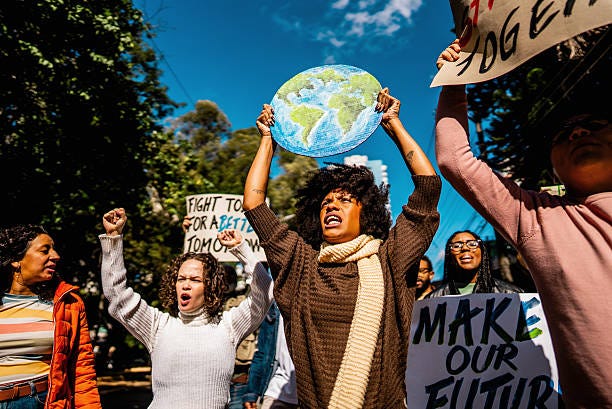
When people think about climate change, they often picture melting glaciers and rising sea levels. What rarely comes to mind is armed conflict.
Yet for millions of people around the world, climate change is increasingly becoming a security issue, a governance issue, and ultimately a human freedom issue.
Few places demonstrate this reality more clearly than northern Nigeria. Over the past two decades, the region has faced a combination of environmental degradation, and weak governance. The shrinking of water resources, and changing rainfall patterns have placed enormous pressure on communities that depend on farming and livestock for survival. At the same time, ongoing violence linked to insurgent groups such as Boko Haram has deepened instability and displaced millions of people.
The result is a crisis that combines environmental pressure with existing political and security challenges.
A Crisis That Doesn’t Arrive All at Once
Northern Nigeria rarely makes international headlines unless there is an attack, a kidnapping, or a humanitarian emergency. What receives far less attention is the slower crisis unfolding in the background.
The numbers tell a worrying story. Lake Chad, one of the region’s most important water sources, has lost around 90 percent of its surface area since the 1960s according to the United Nations Environment Programme. At the same time, the World Food Programme estimates that more than 33 million Nigerians are facing acute food insecurity, driven by conflict, economic pressures, and climate-related disruptions .
According to the United Nations Development Programme (UNDP), environmental pressures often worsen existing economic and social tensions rather than creating entirely new ones. When livelihoods become uncertain and resources grow scarce, disagreements that once seemed manageable can become much harder to contain.
Can Governments Separate People From the Environment?
Governments are expected to protect citizens from violence and insecurity. That responsibility is widely accepted. What is less discussed is whether governments have an obligation to protect the conditions that allow people to live stable and productive lives in the first place.
Researchers cited by the World Bank have warned that agricultural productivity in parts of Nigeria could decline by between 10 and 25 percent by 2080 if climate pressures continue to intensify. For a country where millions of people depend on agriculture for their livelihoods, that is not simply an environmental challenge. It is an economic and social one.
Governments cannot control rainfall patterns or rising temperatures, but they can improve irrigation systems, invest in infrastructure, support struggling communities, and strengthen institutions before situations become emergencies.
No government can make it rain. But governments can decide whether citizens face environmental challenges alone or with meaningful support.
Key Takeaway
The story of northern Nigeria is not really about climate change alone. It is about what happens when environmental pressures, insecurity, and weak governance collide.
Flooding across Nigeria in 2024 displaced thousands of people and damaged critical farmland, while continuing drought conditions across parts of the Sahel have intensified concerns about food security and migration.
According to the United Nations Environment Programme (UNEP), climate-related risks are increasingly connected to displacement, instability, and humanitarian crises across several parts of the world. Northern Nigeria simply happens to be one of the clearest examples of that reality.
Governments have a responsibility to recognize when the challenges begin threatening people’s ability to live safely and with dignity. Waiting until a humanitarian crisis emerges is often the most expensive response of all.
The debate is not whether governments should protect people or protect the environment. In places like northern Nigeria, protecting one increasingly means protecting the other.